

Why Decatur Drivers See White Smoke From Exhaust and When to Worry
Sharing this:
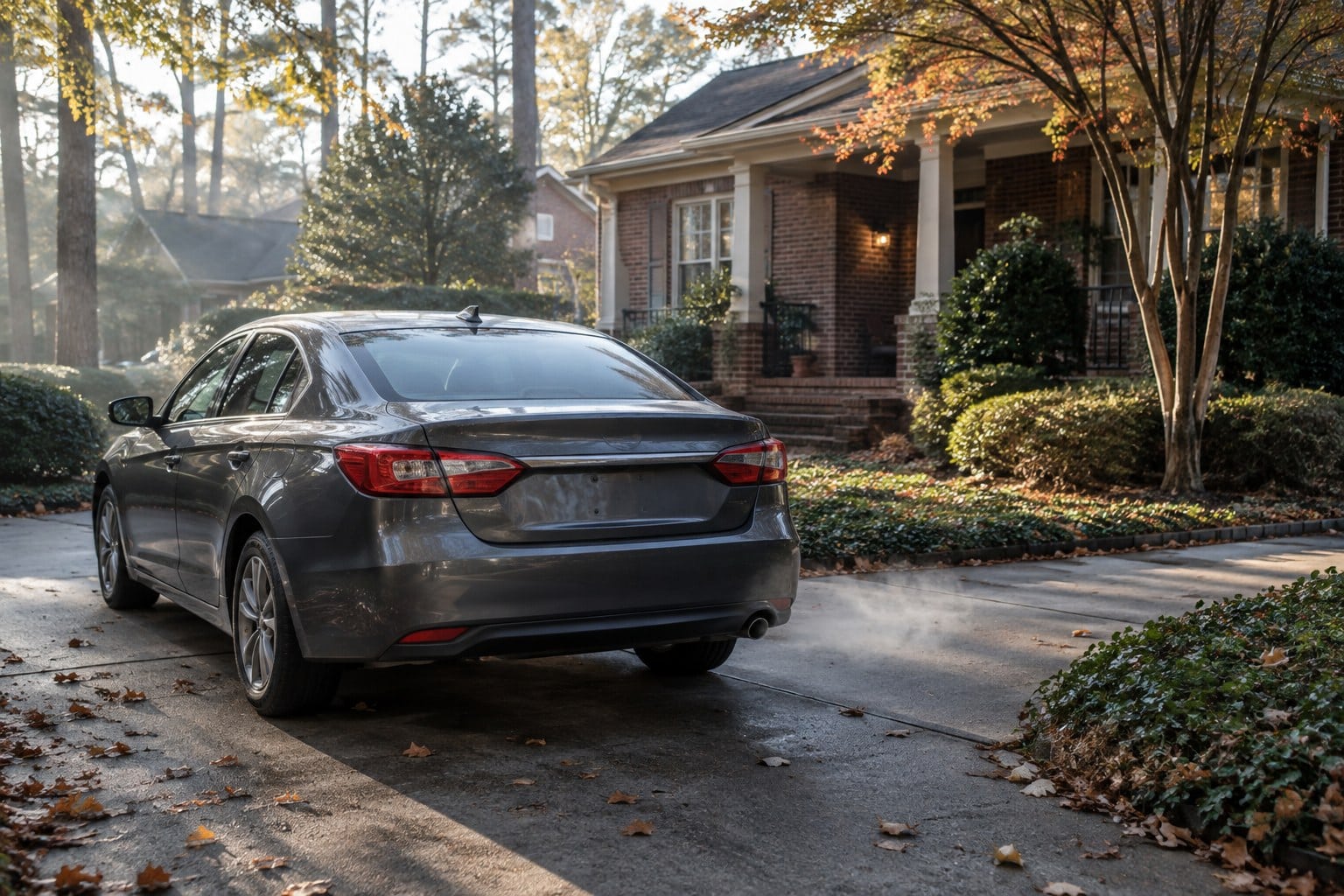
You start your car on a cool morning near the Decatur Square, glance in the mirror, and see white smoke from exhaust drifting across the driveway. Sometimes that cloud means nothing at all. Other times it is the first visible sign of coolant getting into the engine, and waiting can turn a manageable repair into a major one. Our technicians at our Decatur shop look at this exact question every week, and the honest answer is that the color, smell, and timing of the smoke tell you most of what you need to know.
Not sure if the cloud behind your car is normal? Let our team take a look and explain what we find.
Key Takeaways
- Thin white vapor that disappears within a few minutes of a cold start is usually normal condensation burning off.
- Thick, lingering white smoke with a sweet smell often means coolant is burning inside the engine.
- A dropping coolant level with no visible leak is a strong warning sign of a head gasket, cylinder head, or intake gasket problem.
- Continuing to drive with coolant in the combustion chamber can lead to overheating and serious engine damage.
- A cooling system pressure test and combustion gas test can confirm the cause before any parts are replaced.
Decatur sits in a part of metro Atlanta where the weather swings fast. A humid summer night can leave moisture everywhere, and a crisp November morning can drop temperatures enough that every car on Ponce de Leon Avenue seems to be puffing vapor at the stoplight. That is why so many drivers are unsure whether what they see is a problem or just the weather.
The difference matters. A car that blows harmless steam for two minutes is fine. A car that leaves a sweet smelling cloud behind it on the drive down Scott Boulevard toward I-285 may be losing coolant into the cylinders, and that is not something to ignore. Below, we walk through what causes white exhaust smoke, how to tell the harmless kind from the serious kind, and what our technicians check when you bring it in.
What White Smoke From Exhaust Actually Is
Every gasoline engine produces water as a normal byproduct of burning fuel. When hydrocarbons combine with oxygen, the result is mostly carbon dioxide and water vapor. On a warm afternoon, that vapor leaves the tailpipe as an invisible gas. On a cool or damp morning, it hits colder air and condenses into a visible white cloud, the same way your breath does in winter.
Condensation inside the exhaust system
Your exhaust pipes, muffler, and catalytic converter also collect moisture overnight. When you start the engine, hot exhaust gas heats that trapped water and pushes it out as steam. You may even see a few drops of clear water dripping from the tailpipe. This is normal, and it usually clears once the exhaust system reaches operating temperature, often within five to ten minutes of driving.
Burning coolant
The concerning version of white smoke comes from engine coolant (antifreeze) entering the combustion chamber. Coolant is mostly water mixed with glycol. When it burns, it creates a dense white smoke that hangs in the air longer than normal vapor and often smells sweet. This smoke does not go away after the engine warms up. In many cases it gets worse as the engine gets hotter and cooling system pressure rises.
Other colors and what they suggest
White is not the only color you might see. Blue or gray smoke usually points to oil burning, and black smoke usually means the engine is running too rich on fuel. Knowing the color helps narrow the cause before anyone picks up a wrench.
| Smoke Color | Common Cause | Typical Smell | How Urgent |
|---|---|---|---|
| Thin white, gone in minutes | Normal condensation | None or normal exhaust | Not a concern |
| Thick white, lingering | Coolant burning in the engine | Sweet, syrupy | Schedule an inspection soon; stop driving if overheating |
| Blue or gray | Oil burning from worn rings, valve seals, or a turbo issue | Burnt oil | Have it checked promptly |
| Black | Engine running rich on fuel | Raw fuel | Have it checked promptly; fuel economy suffers |
Harmless Causes Decatur Drivers Commonly Notice
Before you assume the worst, it helps to know when white vapor is simply part of owning a car in Georgia.
Cool mornings and humid nights
Metro Atlanta humidity is high for much of the year, and fall and winter mornings bring the cooler temperatures that make vapor visible. Cars parked outside in neighborhoods like Oakhurst, Winnona Park, or Kirkwood often show a bigger cloud than cars parked in a garage, simply because the exhaust and the air around it are colder and wetter.
Short trips that never warm up the exhaust
If most of your driving is a quick run to the Decatur Square, a school drop off, or a few blocks to the MARTA station, your exhaust system may never get hot enough to drive out all the moisture. Water collects again and again, and you see vapor every time you start. Short trip driving also contributes to exhaust components rusting from the inside out, so a longer drive now and then is good for the whole system. Our post on how stop-and-go traffic affects your car explains why this kind of driving is harder on a vehicle than people expect.
How to tell it is just condensation
- The vapor is thin and wispy and disappears quickly into the air.
- It fades after the engine and exhaust warm up.
- There is no sweet smell.
- Your coolant reservoir level stays steady from week to week.
- The temperature gauge reads normal and no warning lights are on.
If all five of those are true, you can usually stop worrying. If any of them are not, keep reading.
Serious Causes of White Smoke From Exhaust

When the smoke is thick, persistent, and sweet smelling, coolant is almost always the culprit. The question is how it is getting into the combustion chamber. These are the most common paths we find.
Blown or leaking head gasket
The head gasket seals the joint between the engine block and the cylinder head. It keeps combustion pressure, engine oil, and coolant in their own separate passages. When it fails between a coolant passage and a cylinder, coolant seeps into the cylinder and burns. Head gasket failures often follow an overheating event, which is one reason we always ask whether the temperature gauge has climbed recently. If your car has run hot at any point, our post on what causes a car to overheat is worth reading.
Warped or cracked cylinder head
Severe or repeated overheating can warp an aluminum cylinder head, and in some cases crack it. A warped head can no longer clamp the gasket evenly, so coolant finds a path into the cylinders. A cracked head can leak coolant even with a brand new gasket installed. This is why we check head flatness when a head gasket job is done, rather than just swapping the gasket.
Failed intake manifold gasket
On many V6 and V8 engines, coolant passes through the intake manifold. When that gasket fails, coolant can be drawn into the intake ports and burned in the cylinders. Some domestic engines are known for this, and the symptoms can look a lot like a head gasket failure even though the repair is usually less involved.
EGR cooler failure
Many diesel engines and some modern gasoline engines use an exhaust gas recirculation (EGR) cooler that runs coolant past hot exhaust gas. If that cooler cracks internally, coolant can enter the intake stream and come out the tailpipe as white smoke. This is a frequent issue on certain diesel trucks and some European models.
When to Worry and What to Do Right Now
White smoke by itself is a symptom, not an emergency. What turns it into an urgent problem is what comes with it.
Pull over safely if you see these signs
- The temperature gauge climbs toward hot or a high temperature warning appears.
- Steam is coming from under the hood rather than the tailpipe.
- The engine is running rough, misfiring, or the check engine light is flashing.
- You smell coolant strongly inside the cabin.
If any of these happen, get off the road as soon as it is safe, turn off the engine, and let it cool. On a busy stretch of I-285 or I-20, take the next exit or move fully onto the shoulder and turn on your hazard lights. Never open the radiator cap or coolant reservoir cap on a hot engine. The system is under pressure, and hot coolant can spray out and cause serious burns. If you see flames or smoke coming from the engine compartment, move everyone away from the vehicle and call 911.
Safe checks you can do at home
Once the engine is completely cool, usually after a few hours, there are a few things you can look at yourself.
- Check the coolant reservoir level against the minimum and maximum marks. Write it down and check again after a few days of driving.
- Pull the oil dipstick. Oil that looks milky, light brown, or like a chocolate milkshake can mean coolant is mixing with oil.
- Look under the car for green, orange, pink, or blue puddles. A missing amount of coolant with no puddle points toward an internal leak.
- Note when the smoke appears: only at startup, constantly, or mainly under acceleration.
If your reservoir keeps dropping, our post on why a coolant reservoir runs empty explains other possibilities to rule out.
Why driving on it makes things worse
Coolant in the cylinders does more than make smoke. It washes oil off the cylinder walls, can foul spark plugs, and can damage the catalytic converter and oxygen sensors over time. Coolant mixing into the oil breaks down lubrication and can damage bearings. And every bit of coolant lost raises the chance of overheating, which can turn a gasket repair into a much larger engine repair. Coolant is also toxic to people and pets, so a leak in your driveway is worth cleaning up.
Seeing smoke that will not clear after warm up? Bring it in before a small leak becomes a big repair.
How Our Technicians Diagnose White Exhaust Smoke

We do not guess at head gaskets. Replacing the wrong part wastes your money and your time, so our process is built to confirm the cause first. Our car diagnostic service combines hands on testing with scan tool data.
Visual and smell check
We start by watching and smelling the exhaust at cold start and after warm up. Thin vapor that clears is noted and usually ruled out. Dense, sweet smelling smoke moves us straight to cooling system testing.
Cooling system pressure test
A pressure tester pressurizes the cooling system to its normal operating level. If the pressure drops and there is no external leak, coolant is going somewhere inside the engine. This test also finds external leaks at hoses, the water pump, and the radiator, which our coolant services team can repair.
Combustion gas (block) test
A chemical block test samples the air above the coolant. If combustion gases are present, the fluid changes color. That is strong evidence that the head gasket, head, or block is allowing combustion pressure into the cooling system.
Scan tool data and spark plug inspection
We read misfire counts, fuel trims, and stored codes. A spark plug that looks steam cleaned compared to the others is often a clue that coolant is entering that cylinder. Our post on how regular diagnostics prevent major repairs shows why catching these patterns early matters.
Repair Options and What Affects the Cost
The fix depends entirely on what we find. Some causes are relatively straightforward and others require taking the top of the engine apart.
Common repairs
- Intake manifold gasket replacement when coolant is entering through the intake.
- EGR cooler replacement on engines that use one.
- Head gasket replacement, often with the cylinder head checked for flatness and resurfaced at a machine shop if needed.
- Cylinder head replacement if the head is cracked.
- Engine replacement in severe cases, such as a cracked engine block.
For larger jobs, our engine repair team walks you through every step before work starts.
What changes the price
Cost depends on your vehicle. A four cylinder engine with easy access is a very different job from a V6 tucked under a cowl or a turbocharged European engine with tight packaging. Labor hours, parts availability, whether machine work is needed, and how much related damage has occurred all play a role. We give you a clear price before any work begins, and we explain the options in plain English so you can decide what makes sense for your car and your budget.
How to Prevent White Smoke Problems
Most coolant related smoke traces back to overheating or neglected coolant. A few habits go a long way.
Keep the cooling system healthy
Coolant breaks down over time and loses its corrosion protection. Follow your owner's manual for coolant replacement intervals, use the type your manufacturer specifies, and never run straight water except in a true emergency. Mixed coolant types can cause problems too.
Stay on top of routine maintenance
Regular inspections let our technicians spot seeping hoses, a weak radiator cap, or a slowly dropping coolant level before they cause trouble. It is also worth checking for open recalls on your vehicle through the NHTSA recall lookup, since some engines have had cooling system or gasket related campaigns.
Want a cooling system check before summer traffic or winter mornings arrive? We can inspect it during your next visit.
Why Decatur Drivers Trust Blue Ridge Automotive - European & Domestic for Exhaust Smoke Diagnosis
When your car is blowing smoke, you want someone who will find the real cause, not sell you the most expensive repair on the menu. That is how we work.
- We test before we replace. Pressure tests, block tests, and leak down tests confirm the problem first.
- Clear pricing. We give you a clear price before any work begins, with no surprises when you pick up your car.
- Plain English explanations. We show you what we found and explain your options without jargon.
- Experience across makes. Our technicians work on European, Asian, and domestic vehicles, from daily commuters to performance cars.
- Highly rated on Google by drivers across Decatur and metro Atlanta.
Our Decatur shop at 803 Church St is an easy drive from Downtown Decatur, Avondale Estates, Druid Hills, and Tucker, and we are open Monday through Friday, 8AM to 5PM.
Frequently Asked Questions
Is white smoke from my exhaust on a cold morning normal?
Usually, yes. Thin white vapor at startup on a cool or humid morning is water condensation burning off the exhaust system. It should fade within several minutes as the engine and exhaust warm up. If the smoke stays thick after the car is fully warm, or it smells sweet, that points to a different problem worth checking.
Can I keep driving if my car is blowing white smoke?
If it is only brief condensation, yes. If the smoke is thick, persistent, and sweet smelling, limit driving and have it inspected soon. Stop driving right away if the temperature gauge climbs or a warning light appears. Continuing to drive with coolant burning in the engine can cause overheating and much more expensive damage.
Does white smoke always mean a blown head gasket?
No. A head gasket is a common cause, but a failed intake manifold gasket, cracked cylinder head, leaking EGR cooler, or diesel fuel issue can produce similar smoke. That is why we run a pressure test and a combustion gas test before recommending any repair. Confirming the cause first keeps you from paying for parts you did not need.
Why is my coolant low but there is no leak under the car?
Coolant that disappears without leaving a puddle is often being burned inside the engine or leaking into the oil. It can also evaporate from a small external seep that drips onto hot parts. Check the oil dipstick for a milky look and have the cooling system pressure tested to find out where the coolant is going.
How long does a white smoke diagnosis take?
In many cases our technicians can complete the visual check, pressure test, and combustion gas test the same day. More involved testing, such as a leak down test on an engine with tight access, may take longer. We will tell you what we plan to test and give you a clear price before any work begins.
White smoke from exhaust is often nothing more than morning condensation, but when it is thick, sweet smelling, and sticks around after warm up, it is your engine asking for attention. Watching your coolant level, temperature gauge, and oil condition helps you catch the problem early. Drivers from Decatur, Avondale Estates, Kirkwood, Druid Hills, Tucker, and East Atlanta can count on our team for honest testing and clear answers.
Ready to Get Started with Blue Ridge Automotive - European & Domestic?
If your car is leaving a white cloud behind it that will not clear, do not wait for the temperature gauge to make the decision for you. Our technicians will find the cause, explain it in plain English, and give you a clear price before any work begins. Reach out at (404) 549-9424 today to schedule your visit at our Decatur shop.