

How a Car's Cooling System Works: A Simple Guide for Marietta Drivers
Sharing this:
Most drivers think a cooling system just keeps the engine from overheating. That's true, but it undersells what the system actually does. Understanding how a car cooling system works means knowing it also moves heat to where it's useful, like the cabin heater, and protects metal parts from warping during Atlanta's long summers. Our team at Blue Ridge Automotive, European & Domestic has serviced cooling systems on European and domestic vehicles out of our Chamblee shop since 2021, and we wrote this guide so you can spot trouble before it turns into a larger problem. A modern cooling system manages a narrow temperature band the engine has to live inside, roughly 195 to 220 degrees, and a few degrees outside that window is the difference between normal operation and a warped cylinder head.
That margin matters more here than it would in a cooler climate. Stop-and-go traffic on I-285, sustained summer highs in the upper 80s and 90s, and the kind of slow crawl you get heading into Buckhead on a Friday afternoon all push thermal load onto a system that's already working hard. A cooling setup that's "good enough" in a milder city becomes a roadside breakdown here.
Cooling systems do a lot of work behind the scenes, and understanding the main components that keep them running, along with the warning signs of trouble, can save you from bigger problems down the road. Cooling-related repairs climb every summer, and most of them are preventable with earlier attention.
Worried about your coolant or temp gauge? Schedule a cooling system inspection at our Marietta shop.
Key Takeaways
- The cooling system does three jobs: absorbing heat from the engine block, moving it through coolant, and releasing it at the radiator.
- The water pump, thermostat, radiator, and coolant all have to work together, and one weak link takes the whole system down.
- Atlanta's heat and stop-and-go traffic accelerate coolant breakdown, which is why flush intervals matter more here than in cooler climates.
- Catching a cooling problem early makes a significant difference in repair scope.
What the Cooling System Is Actually Doing (And Why the Engine Needs It)
A cooling system does not just cool. It manages heat in both directions, pulling excess heat out when the engine is working hard and holding heat in when the engine is cold. That two-way job is what most drivers miss, and it is why a small cooling fault can cause big problems fast.
The Heat Problem Internal Combustion Creates
Combustion inside your cylinders briefly hits temperatures over 2,500°F. Only about 30% of the energy in your fuel actually becomes motion at the wheels. The rest turns into heat absorbed by the engine block, the pistons, the cylinder head, and the exhaust.
Without active heat removal, aluminum and cast iron components warp, seize, or crack within minutes. This is not an overheating "event." It is a sustained thermal management problem the system has to solve every second the engine is running.
Material matters here. Older domestic engines used heavier cast iron, which tolerates short heat spikes better. Most European engines, BMW and Mercedes especially, run aluminum-heavy blocks and heads. Aluminum dissipates heat well, but it also warps faster when coolant flow stops. That is why a European engine with a stuck thermostat or a failed water pump can be ruined in a single drive home from Decatur, where a comparable Ford or Jeep might survive the same mistake. If you drive a European car, our European auto repair team takes cooling complaints seriously for exactly this reason.
Why Cooling Is Only Half the Job
Here is the part most explainers skip. Your engine also needs to stay warm. A cold engine wastes fuel, raises emissions, and wears out faster because the oil is too thick to flow properly through tight bearing clearances.
The thermostat is what makes both jobs possible. It holds coolant inside the engine block until the engine reaches about 195°F, then opens and lets coolant flow to the radiator. From that point on, it works to keep the engine in a narrow 195-220°F window across wildly different conditions, a 28-degree January morning in Decatur and a 95-degree afternoon crawling up Peachtree Street with the AC on full.
That window is tight on purpose. Too cold and the engine is inefficient. Too hot and head gaskets fail, oil breaks down, and aluminum components start to move out of spec. The system is not trying to make the engine cold. It is trying to hold it at the exact temperature the engineers designed it to run at.
This is also why a "stuck open" thermostat is a real problem even though it does not cause overheating. The engine never reaches full operating temperature, fuel economy drops, the cabin heater feels weak, and the computer keeps the fuel mixture rich longer than it should. Cooling problems are not always hot problems.
If your temperature gauge has been reading lower than usual, or the heater takes forever to warm up on cold Tucker or Brookhaven mornings, that is worth a look. Call our shop at the Chamblee location to schedule a cooling system inspection before the next temperature swing.
The Main Components and What Each One Does
Four parts do most of the work in your cooling system: the radiator, the water pump, the thermostat, and the coolant itself. Each one has a specific job, and when any of them fails, the others can't compensate for long. Here's what each one actually does and how it fails in the real world.
The Radiator: Where Heat Leaves the System
A radiator is an aluminum tube-and-fin heat exchanger. Hot coolant enters through the upper hose, snakes through thin flat tubes, and exits cooler through the lower hose. The fins between those tubes give the heat a huge surface area to escape into the air flowing through the grille.
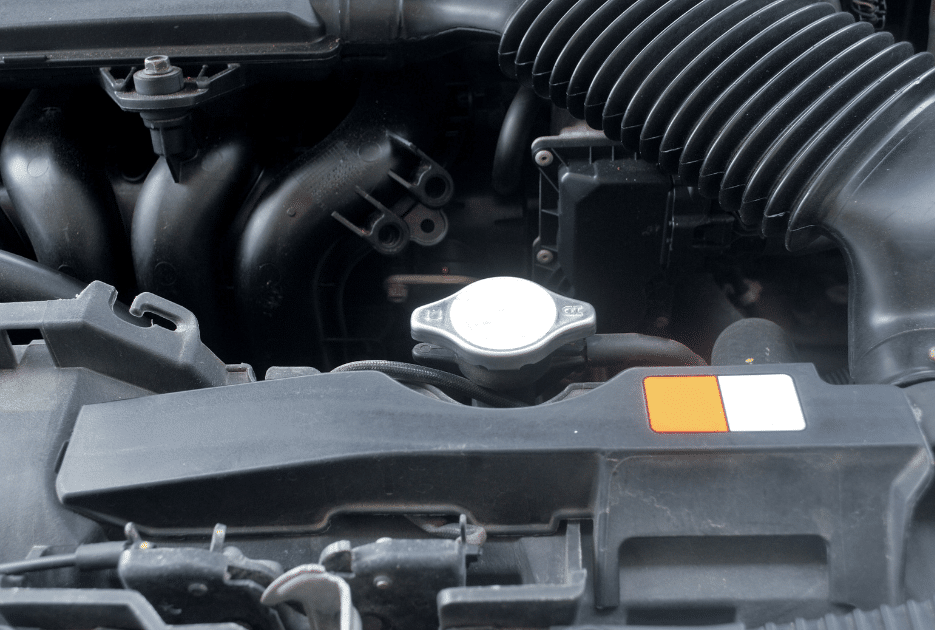
The pressure cap is the part most drivers underestimate. It holds the system at roughly 16 PSI, which raises the boiling point of the coolant from 212°F to around 265°F. That pressure is what keeps the coolant liquid at temperatures that would otherwise turn it to steam.
Never twist a hot radiator or reservoir cap. Releasing 16 PSI of superheated coolant sends a geyser of 250°F liquid straight up. We have seen burn injuries from it, and there's no honest way around the rule: let it cool first.
Radiators usually fail at the plastic end tanks or at corroded tube seams. If you see green, orange, or pink residue on the front of the engine bay, or a sweet smell after a drive, that's a leak. Our coolant leak repair cost guide walks through what those repairs typically run.
The Water Pump: What Keeps Coolant Moving
The water pump is a centrifugal pump with an impeller that spins coolant through the engine block, into the head, out to the radiator, and back. On most domestic engines and older imports, the serpentine belt or timing belt drives it mechanically. On many newer BMW, Audi, and Mercedes engines, it's electric and controlled by the ECU so coolant flow can be tuned to load and temperature.
The natural assumption when an engine overheats is that it's low on coolant. The actual answer is often a failing water pump. If the impeller is cracked, corroded, or spinning loose on its shaft, you can have a full reservoir and still cook the engine because nothing is moving the fluid.
Early warning signs of water pump car cooling failure:
- Grinding or whining from the front of the engine
- A wet trail or crusty residue at the weep hole under the pump
- Temperature gauge that climbs in traffic but drops at highway speed
- Sweet-smelling steam from the engine bay
If you've noticed your overflow tank running low between checks, an empty coolant reservoir often points to a weeping water pump or a slow leak before any gauge spike shows up.
On European engines, electric pump failure often throws a specific code before you ever see a temperature spike. That's one reason scan-tool diagnosis matters on these cars, not just a visual check.
The Thermostat: The System's Traffic Controller
The thermostat is a wax-pellet valve that opens around 195°F. Below that, it stays closed so the engine warms up quickly. Above it, the wax melts, expands, and pushes the valve open so coolant can flow to the radiator.
Stuck open, the engine never reaches full operating temperature. You'll see worse fuel economy, weak heat from the vents in winter, and long-term carbon buildup. Stuck closed is worse. Coolant stops circulating to the radiator and the temperature gauge climbs fast, sometimes within a few minutes of start-up.
BMW and Mercedes often use electronically controlled map thermostats. The ECU varies opening temperature based on load, throttle position, and ambient temperature. When these fail, you don't just overheat, you get a check engine light and a stored fault code. We see this regularly on N20, N55, and M276 engines that come through our Buckhead and Marietta bays.
Coolant Itself: More Than Just Antifreeze
Coolant is a 50/50 mix of ethylene glycol and distilled water. It does three jobs at once: it lowers the freeze point to around -34°F, it raises the boil point when combined with system pressure, and it carries corrosion inhibitors that protect the aluminum, iron, and rubber inside the system.
Those inhibitors are why coolant chemistry matters. There are three main families: IAT (the old green stuff), OAT (orange, pink, or red long-life formulas), and HOAT (hybrids common in European and some domestic cars). Manufacturers spec a particular formula because the inhibitor package is matched to the metals and gaskets in that specific engine.
Using the wrong coolant rarely causes an immediate problem. It quietly destroys the water pump seal, the heater core, or the radiator end tanks over 15,000 to 20,000 miles. By the time you notice, the damage is done. If you're not sure what's in your system, ask. We check coolant type and condition on every service.
One more thing about summer in the metro area: your AC system and cooling system share the same airflow through the front of the car and the same workload when temperatures climb. If your AC is struggling, the cooling system is usually working harder too. Our guide on AC recharge intervals explains how the two systems lean on each other in Georgia heat.
If Something Feels Off, Don't Wait
If your temperature gauge is climbing, you're smelling something sweet from under the hood, or you've spotted coolant on the driveway, bring it in before a small repair turns into a warped head or a cracked block. Engine overheating prevention is mostly about catching small failures early.
Founded in 2021 and based at 3733 N Peachtree Rd in Chamblee, our team services European and domestic vehicles across four locations. Cooling system diagnosis is one of the most common jobs we handle from May through September.
Schedule a cooling system inspection at the location nearest you. Call Buckhead at (404) 266-1699, Chamblee at (770) 216-8474, Decatur at (404) 549-9424, or Marietta at (770) 426-4220.
Catching a weeping water pump or a tired thermostat now is far less involved than what an overheated engine requires later.
Frequently Asked Questions
How Often Should I Flush My Coolant?
Most manufacturers recommend a coolant flush every 30,000 to 50,000 miles, though some extended-life formulas can last up to 100,000 miles. The interval depends on your vehicle make, coolant type, and driving conditions in Atlanta, where stop-and-go traffic puts extra stress on the system. Blue Ridge Automotive can test your coolant's pH and freeze point to determine whether a flush is actually due or whether you still have service life remaining.
Can I Top Off My Coolant With Water in an Emergency?
Plain water can be used as a short-term fix if you are losing coolant and have no other option, but it should never be treated as a permanent solution. Water alone raises the freezing point, lowers the boiling point, and causes corrosion inside metal components over time. Have the system properly inspected and refilled with the correct coolant mixture as soon as possible after any emergency top-off.
Is It Safe to Drive With a Slightly High Temperature Reading?
No. Even a temperature gauge that creeps slightly above the normal range is a warning that the system is struggling, and continuing to drive risks warped cylinder heads or a cracked engine block. The damage from overheating can cost several times more to repair than the original cooling system problem. If your gauge rises above normal, pull over safely and call Blue Ridge Automotive before driving the vehicle further.
Does My Cooling System Work Differently in Atlanta's Summer Heat Compared to Winter?
Yes, extreme summer heat reduces the temperature difference between your coolant and the outside air, which makes the radiator less efficient at shedding heat. Atlanta summers mean your system is working near its upper limits more often than it would in a cooler climate. Winter brings the opposite concern, where the antifreeze mixture must be strong enough to prevent freezing during overnight temperature drops, which do occur in the Atlanta region.
What Is the White Residue Around My Coolant Reservoir Cap?
A white or crusty residue around the cap or overflow tank is usually a sign that coolant is leaking past a seal or that the system is building excessive pressure and venting steam. It can also indicate a failing head gasket if the residue has an oily or milky texture mixed in. Either way, this is not a cosmetic issue, and Blue Ridge Automotive recommends having it inspected promptly to identify the source before the leak worsens.
Will a New Thermostat Solve My Overheating Problem on Its Own?
A faulty thermostat is one common cause of overheating, but it is rarely the only possible cause. A clogged radiator, a worn water pump impeller, a blown head gasket, or a cracked hose can all produce similar symptoms. Replacing only the thermostat without diagnosing the full system first is a common mistake that leads to repeat visits, so a thorough pressure test and inspection should accompany any thermostat replacement.
How Long Does a Cooling System Repair Typically Take at a Shop?
A straightforward repair like a hose replacement or thermostat swap usually takes one to two hours. A water pump replacement on most European or domestic vehicles runs two to four hours depending on engine layout and accessibility. More involved work such as a radiator replacement or head gasket repair can require a full day or longer, and Blue Ridge Automotive will give you a time estimate specific to your vehicle before any work begins.
Ready to Get Started with Blue Ridge Automotive – European & Domestic?
Understanding how the cooling system works is the first step. Catching a weak hose, a tired water pump, or coolant that's lost its corrosion protection is the second, and it's the one that saves the engine. Most cooling system inspections take under an hour and turn up the small problems that become big ones in July traffic on I-75.
Blue Ridge Automotive has been servicing European and domestic vehicles across the metro Atlanta area since 2021. Whether you drive a BMW that's due for its electric water pump, a Mercedes with a plastic coolant housing, or a domestic truck pulling loads through Cobb County summers, our team has worked on it.
To speak directly with our team, call Buckhead at (404) 266-1699, Chamblee at (770) 216-8474, Decatur at (404) 549-9424, or Marietta at (770) 426-4220.
Reach out today and let's talk about how we can help.