
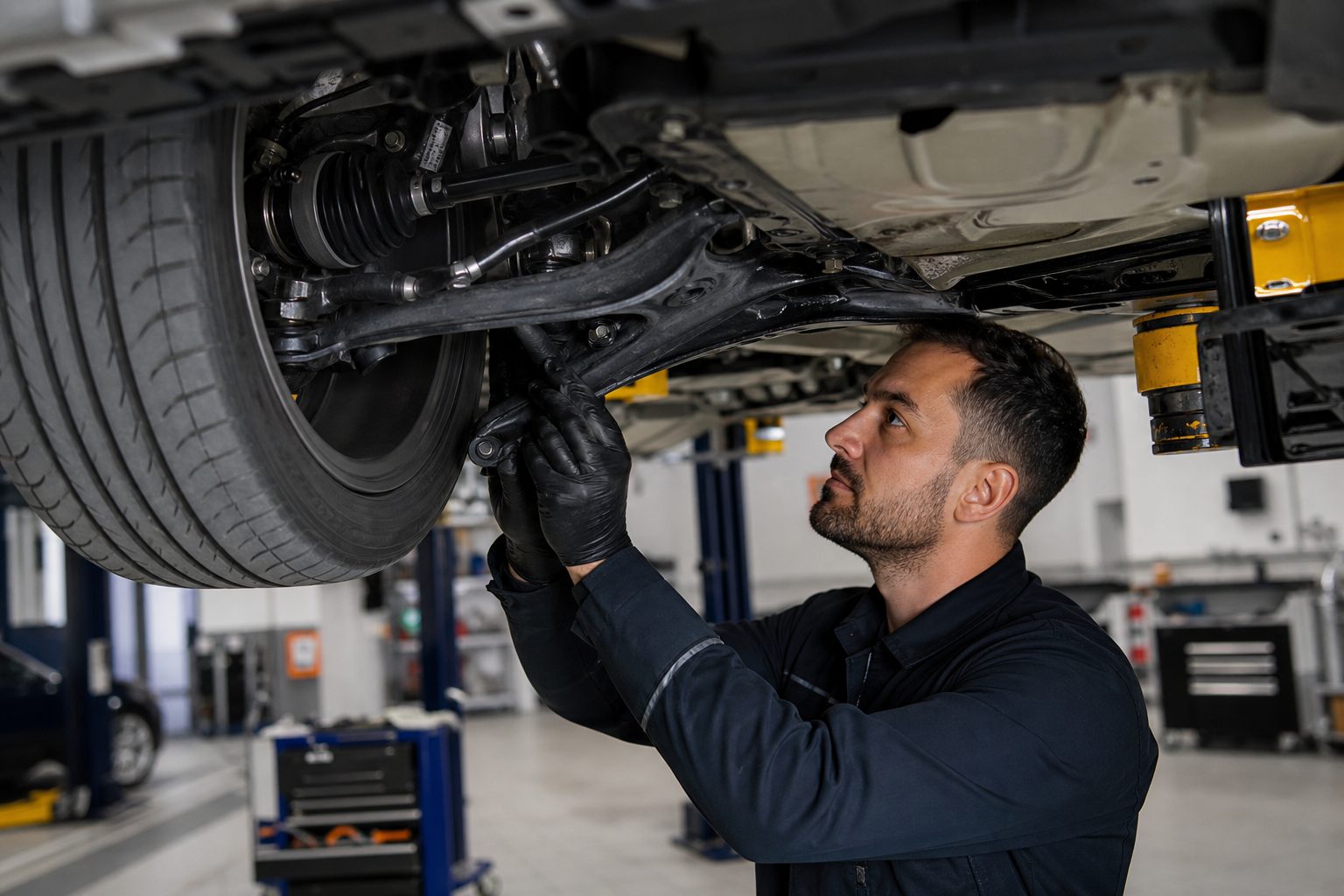
What Those Steering Symptoms Actually Mean
You're merging onto the highway and the steering wheel is pulling left. Not dramatically, but enough that you're holding it off-center just to go straight. Or you hit a rough stretch of road and something clunks hard underneath the car. Both sensations are telling you something specific: a worn tie rod end, a failing strut mount, or a ball joint that's lost its tolerance. These aren't noises worth waiting out.
Deferring that clunk costs more than fixing it. A worn strut that goes ignored starts chewing through tires unevenly and loads the adjacent ball joints beyond their design limit. One deferred repair becomes two or three. And because strut condition directly affects how your vehicle stops, a soft or blown strut can compromise your brake performance under hard stops.
What Steering and Suspension Repair Actually Covers
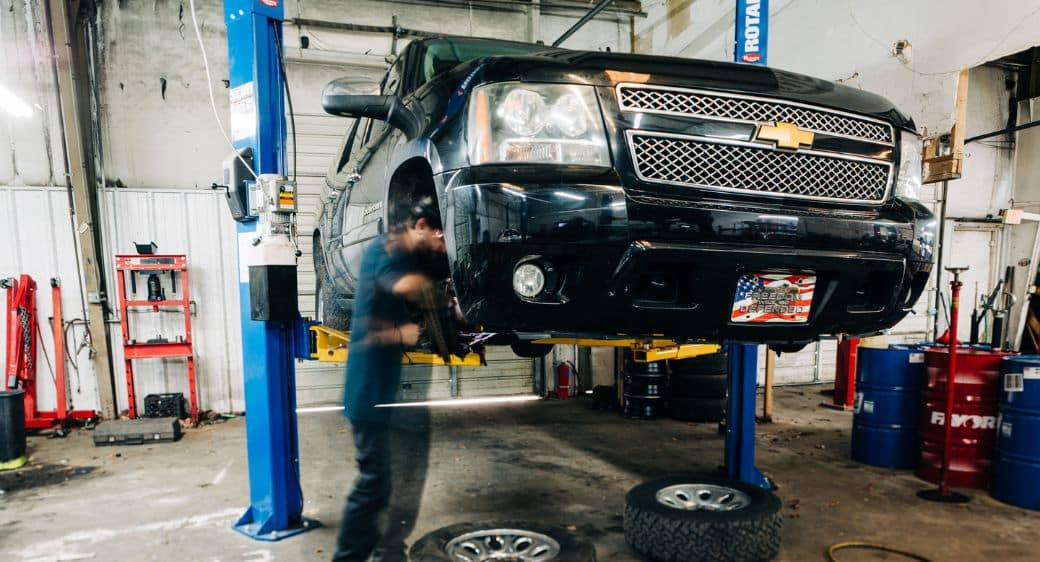
These are two separate systems that work together, and most drivers don't realize how tightly connected they are. Your steering system includes the tie rods (metal rods that connect the steering rack to your wheels), the rack and pinion (the gear mechanism that translates your steering wheel input into wheel movement), and the steering column itself. Your suspension system includes shocks and struts (the dampeners that absorb road impact), control arms (the hinged links that connect your wheels to the frame), ball joints (the pivot points that let the wheel move up, down, and side to side), and sway bar links (short rods that keep the car from leaning too hard in corners).
Here is where it matters for your wallet: worn suspension geometry shifts your steering angles. When a ball joint wears loose or a control arm bushing collapses, your wheels no longer point where the geometry says they should. That misalignment shows up as uneven tire wear, a pull to one side, and handling that feels vague or unpredictable. A wheel alignment can confirm the problem, but alignment alone won't fix worn parts underneath it.
Why Atlanta Driving Accelerates This Wear
City streets take a beating and come back with fresh potholes. Each impact loads your ball joints and struts at angles they weren't built to absorb over and over. Add daily stop-and-go miles and you've got conditions that push a vehicle past the 60,000-mile wear threshold faster than highway driving ever would. Higher-mileage vehicles feel it first.
A full steering and suspension inspection covers all of the following:
Struts
Shock and strut inspection and replacement
Ball Joints
Ball joint diagnosis and replacement
Tie Rods
Tie rod end and inner tie rod repair
Bushings
Control arm and bushing service
Sway Bar
Sway bar link and end link replacement
Steering Rack
Steering rack and power steering system repair
What's Included in Our Steering and Suspension Service
Every suspension job we do starts with a full inspection before any parts get quoted. That's not a formality. Worn components often hide behind symptoms that look like tire problems or brake pull. We check everything load-bearing and articulating first, then talk numbers.
Full Suspension System Inspection
A technician checks every pivot point, bushing, and joint for play, corrosion, and wear before any work is recommended. Nothing gets quoted blind.
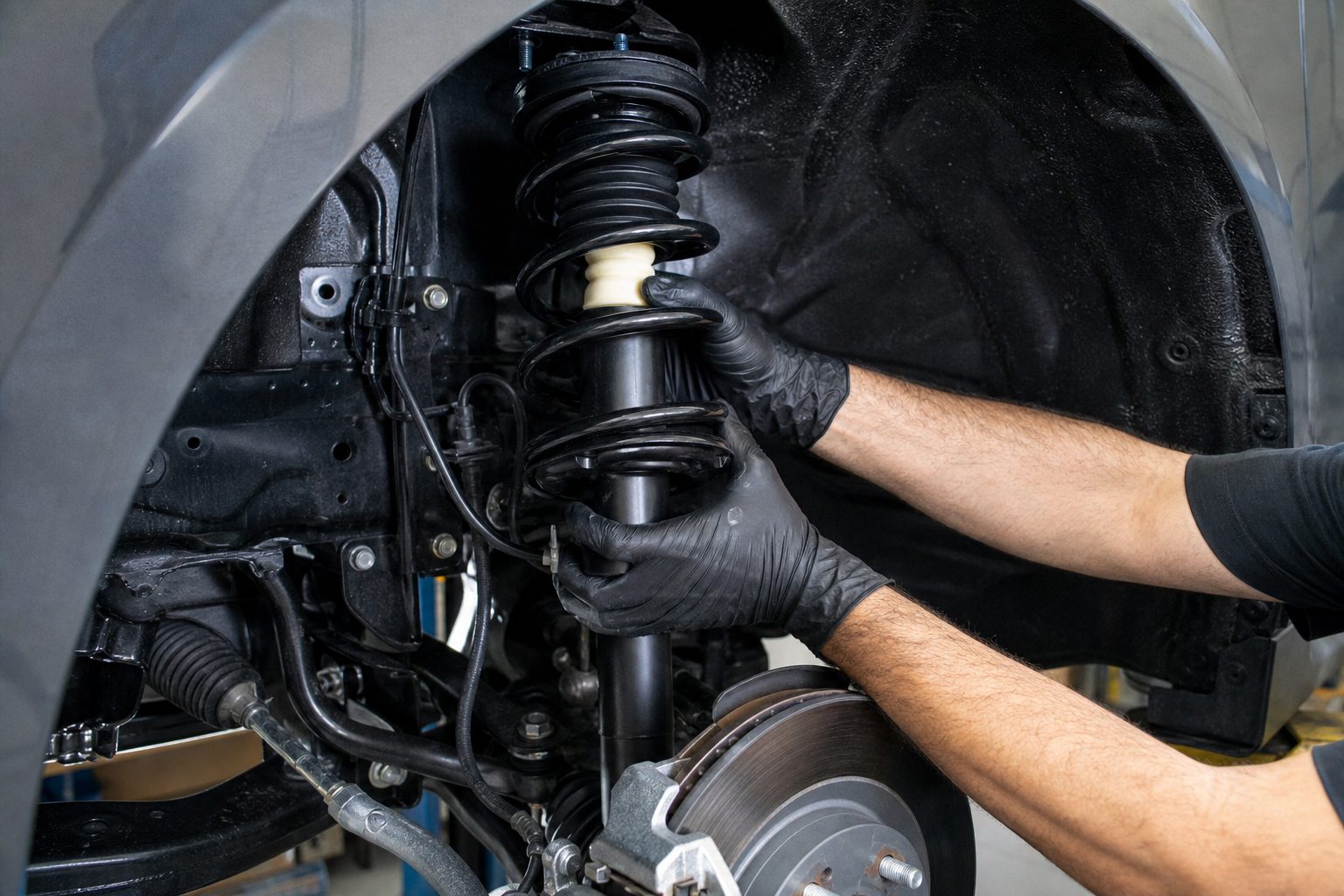
Shock and Strut Replacement
Struts are replaced in axle pairs, not one at a time. A single new strut paired with a worn one creates uneven damping and pulls the car toward the weaker side.
Ball Joint Diagnosis and Replacement
The ball joint is the pivot connecting your wheel hub to the control arm. Worn ball joints clunk on turns and, in severe cases, allow the wheel to separate from the vehicle entirely.
Tie Rod and Steering Linkage Repair
Tie rods transmit steering input from the rack to each wheel. A loose tie rod causes steering wander and chews through tire tread unevenly.
Control Arm and Bushing Service
Bushings are rubber or polyurethane sleeves that absorb road vibration. Age and heat crack them over time, and cracked bushings send every impact straight into the cabin.
Post-Repair Wheel Alignment Check
New suspension parts installed on misaligned geometry wear out faster than the originals. After every suspension repair, we verify and correct all alignment angles. Our wheel alignment service is part of the job, not an upsell.
How Our Suspension Repair Process Works
Every suspension job at our shop follows the same four-step sequence. No guessing, no replacing parts until we know what's actually wrong. Here's what happens from the moment you pull in to the moment you drive out.
Step 1: Road Test to Replicate the Symptom
A technician drives your vehicle before touching a wrench, feeling for the pull, clunk, or wander you described. Suspension problems don't always throw a code. The road test tells us what the code reader can't.
Step 2: Full Lift Inspection of Every Component
The car goes up on the lift and every ball joint, tie rod, bushing, strut mount, and sway bar link gets physically checked for play, corrosion, and wear beyond spec. Rough roads leave clear evidence on components when you know where to look.
Step 3: Parts Installation to OEM-Equivalent Spec or Better
We install OEM-equivalent or better parts using manufacturer-specific torque values for each make. That matters whether you drive a BMW, a Nissan, or anything in between. European geometry specs and domestic specs are not interchangeable, and we treat them accordingly.
Step 4: Alignment Check and Final Road Test
After installation, we run a four-wheel alignment check to confirm geometry is within spec. Then the technician road tests the vehicle again. The symptom has to be gone before the car goes back to you.
Signs Your Suspension or Steering Needs Attention in Atlanta
Most suspension problems announce themselves from the driver's seat. You don't need a diagnostic code to know something is off, just an idea of what to listen and feel for.
Steering Wheel Pulls to One Side
Let go of the wheel on a flat stretch and the car drifts left or right. That's either an alignment problem or a worn tie rod, the rod that connects your steering rack to the wheel hub. Left uncorrected, it also chews through tires unevenly.
Clunking or Knocking Over Bumps
That metallic clunk crossing a speed bump or dropping into a pothole is usually a ball joint or strut mount. Ball joint replacement is one of the more common repairs we see, and ignoring it long enough turns a straightforward fix into a safety issue.
Harsher Ride on Atlanta Roads
When shocks lose their damping ability, every surface crack rattles through the cabin. Older surface streets will make worn shocks obvious fast.
Uneven or Cupped Tire Wear
Scalloped or single-edge tread wear is a suspension and alignment problem, not just a tire problem. Replacing the tires without fixing the cause means you'll pay twice.
Nose-Dive Under Braking
If the front dips sharply when you brake hard, the front struts are worn and can't manage weight transfer. Worn struts also extend stopping distances, which is why this symptom connects directly to your brake system's overall performance.
Loose or Vague Steering at Speed
Constant small corrections to hold a lane points to a worn steering rack or tie rod ends that are beyond spec.
What Wears Out Steering and Suspension
The honest answer is that everyday roads do not give suspension components an easy life, and waiting until something fails completely is always the more expensive path. If your vehicle is past 60,000 miles, scheduled preventative maintenance is the most straightforward way to catch worn components before they take out something connected.
Constant Compression and Rebound
Your suspension is compressing and rebounding on every bump, dip, and grade you drive over.
Every cycle adds wear to your shocks and struts. Do that five days a week, and those cycles stack up fast.
Rubber Bushings and Corrosion
Rubber bushings are the small cushioning sleeves that sit inside control arms and sway bar links, and age and temperature change degrade them over time.
Heat makes them soft and pliable. Cold makes them stiff and brittle. Cycle through that enough times and they crack, which lets metal contact metal and turns a worn bushing into a clunking noise you feel through the floorboard. Surface rust on exposed control arms and sway bar links accelerates wear at every joint.
Potholes and Impact Loads
Then there is the road surface itself. Aging streets follow a predictable pattern: potholes deliver sharp impact loads to ball joints and strut mounts, and the repair cycle starts again.
Uneven pavement and parking surfaces compound the problem. Your suspension regularly absorbs impacts at off-axis angles, loads it was never designed to handle repeatedly.
Drivers logging daily miles hit the 60,000-mile wear threshold on shocks, struts, and ball joints sooner than they expect.
Why Atlanta Drivers Choose Blue Ridge Automotive for Suspension Work
Transparent Diagnosis
Before we touch a single bolt, you know exactly what needs replacing and why. A clunk over a pothole can be a sway bar bushing, a strut mount, a control arm, or a worn tie rod end, and those are very different repair bills. We road test, put the car on the lift, and show you the play we found before quoting a part. Nothing gets added to the order without your approval, and you get a written estimate before any work starts.
European, Domestic, and Asian Vehicle Experience
Suspension geometry is not universal. A Subaru's rear multi-link setup has different torque specs and alignment targets than a Volkswagen's front MacPherson strut arrangement, and getting those values wrong puts you back in the same problem inside six months. We work on the full range of makes, from BMW repair and service to Nissan repair and service, pulling manufacturer specs for every job instead of generic estimates. That's why drivers bring us their European and Asian vehicles specifically.
Attentive Service You Can Count On
We've earned a 4.9-star rating across 1,000+ reviews, and it shows in how we work. You won't get passed around or treated like a ticket number here. The advisor who takes your drop-off call is usually the same one explaining what the road test found, because we treat every car like it belongs to a neighbor. Most completed steering and suspension repairs carry our 24-month, 24,000-mile nationwide warranty on parts and labor.







Vehicle Brands We Service
From Asian reliability to American work-ready performance, our ASE-certified technicians service every major make. Pick your brand to see model-specific repair details.






























Our Car Repair Shop Locations
We handle automotive repair for drivers across the Atlanta area, not just one zip code. If your steering feels off or your ride has gotten rough, chances are we serve your neighborhood too.
Ready to Fix That Pull, Clunk, or Wander?
That pull to one side gets worse on uneven streets, not better. The clunk you hear over every bump isn't going away on its own. Book a suspension inspection with Blue Ridge Automotive - European & Domestic and find out exactly what's wrong before the repair bill grows.
If your alignment is off, our wheel alignment service is typically done the same visit. You can schedule directly and be back on the road the same day in most cases.
Your steering shouldn't feel like a guess. Schedule a suspension inspection today and get a straight answer. Call us today at (404) 266-1699.
Learn More Before Your Visit
Want to understand the problem before you come in? Our technicians cover the most common questions in How Atlanta Drivers Can Tell Their Shocks and Struts Are Worn Out, How To Know When To Replace Shocks and Struts: 12 Signs To Watch Out For:, and Leveling Kit vs Lift Kit: Pros & Cons.
Still have questions? Our auto repair FAQ answers the questions we hear most, and our service areas page shows every neighborhood our four shops serve.
Frequently Asked Questions