
Atlanta Oil Change: Know What You’re Dealing With Before You Spend a Dollar
You're sitting in a quick-lube bay watching the clock while someone behind the counter asks conventional or synthetic. You pick one, a number goes on a sticker, and you drive off. That's the entire transaction, and it tells you nothing about what your engine actually needed.
Here's the truth: an oil change is not the same at every shop. A BMW requiring LL-01 approval or a Volkswagen needing 502.00-spec oil will suffer real engine damage over time if the wrong fluid goes in. Those are manufacturer approval codes defining the oil's chemical makeup, not just its viscosity, and a quick-lube counter doesn't always catch the difference.
Blue Ridge Automotive - European & Domestic handles imported and domestic vehicles alike and knows the difference between a spec code and a suggestion. We carry a 4.9-star rating across 1,000+ reviews, and that number reflects the work done under the hood, not a comfortable waiting room.
What Oil Change Service Actually Covers
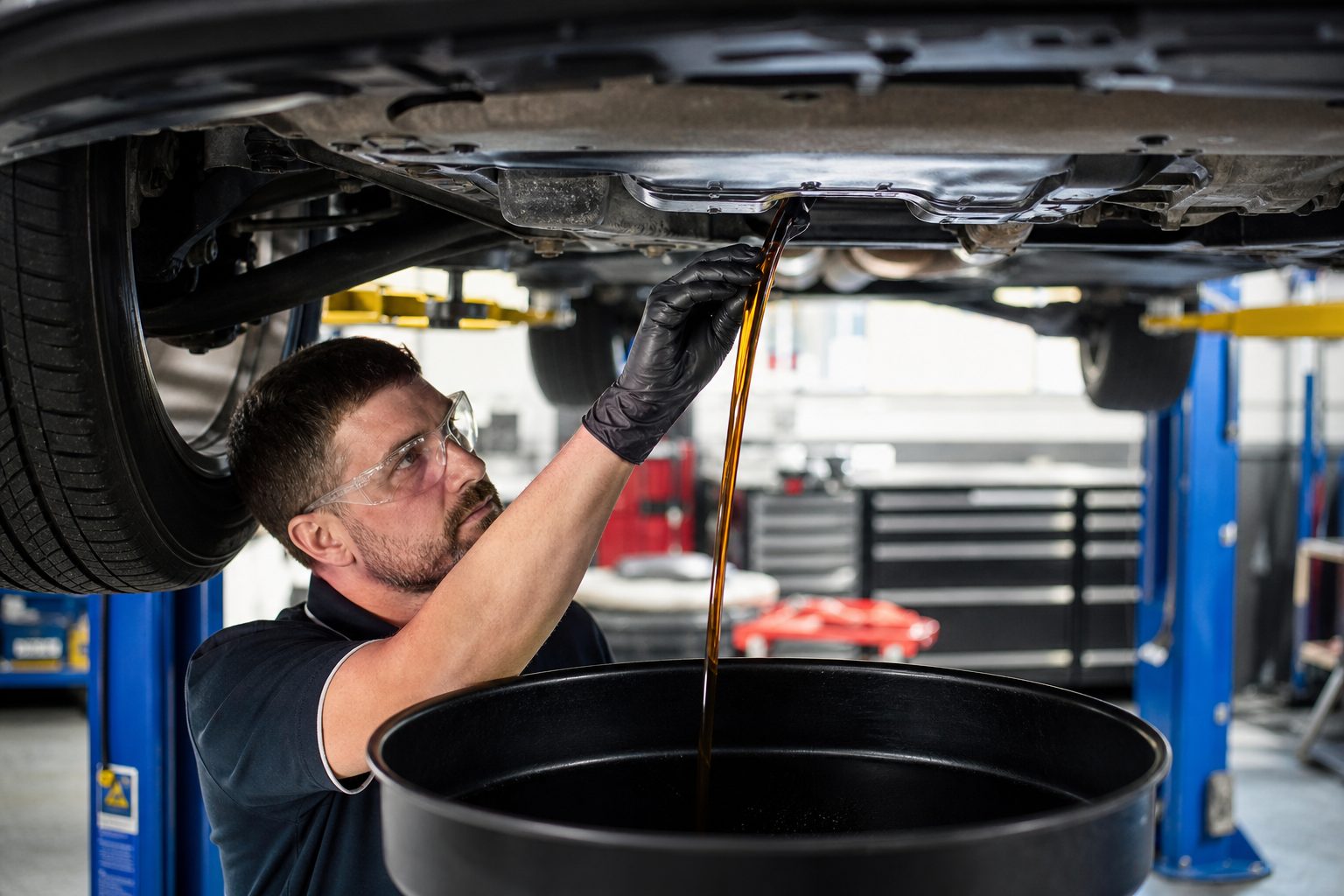
A proper oil change is not a drain-and-fill. Every vehicle that comes through our shop gets the full sequence: complete drain of old oil, OEM-equivalent filter replacement, drain plug and gasket inspection, and the correct oil spec matched to that specific engine. We check actual oil condition, not just the odometer reading, before recommending an interval. Skipping that step is how deferred maintenance quietly turns into a costly engine repair.
Oil spec matters more than most drivers realize. A generic API-rated oil may meet minimum standards, but it does not meet the manufacturer approval codes that many engines require. BMW’s LL-01 spec, VW’s 502.00/505.00, and Mercedes-Benz 229.5 are not interchangeable with conventional or generic synthetic oils. Using the wrong spec can void your warranty and accelerate wear on turbochargers and variable valve timing components. We stock OEM-approved synthetics for both imported and domestic vehicles, so the oil going into your engine is the oil the manufacturer actually called for.
Daily gridlock and heavy idling also shorten the effective life of your oil faster than the mileage sticker assumes. Our preventative maintenance service accounts for those real-world conditions, not just the factory default interval.
Every oil change includes all of the following:
Drain
Full drain of old oil, no top-offs
Filtration
OEM-equivalent filter replacement
Oil Spec
Correct oil weight and manufacturer approval spec matched to your vehicle
Sealing
Drain plug and gasket inspection
Verification
Post-fill oil level and pressure check
Inspection
Multi-point visual inspection of fluids, belts, and hoses
What's Included in Our Oil Change
A lot of shops hand you a sticker and call it done. Here's what actually happens during every oil change we perform, start to finish, from the drain plug to the dipstick.
Manufacturer-Spec Oil Selection
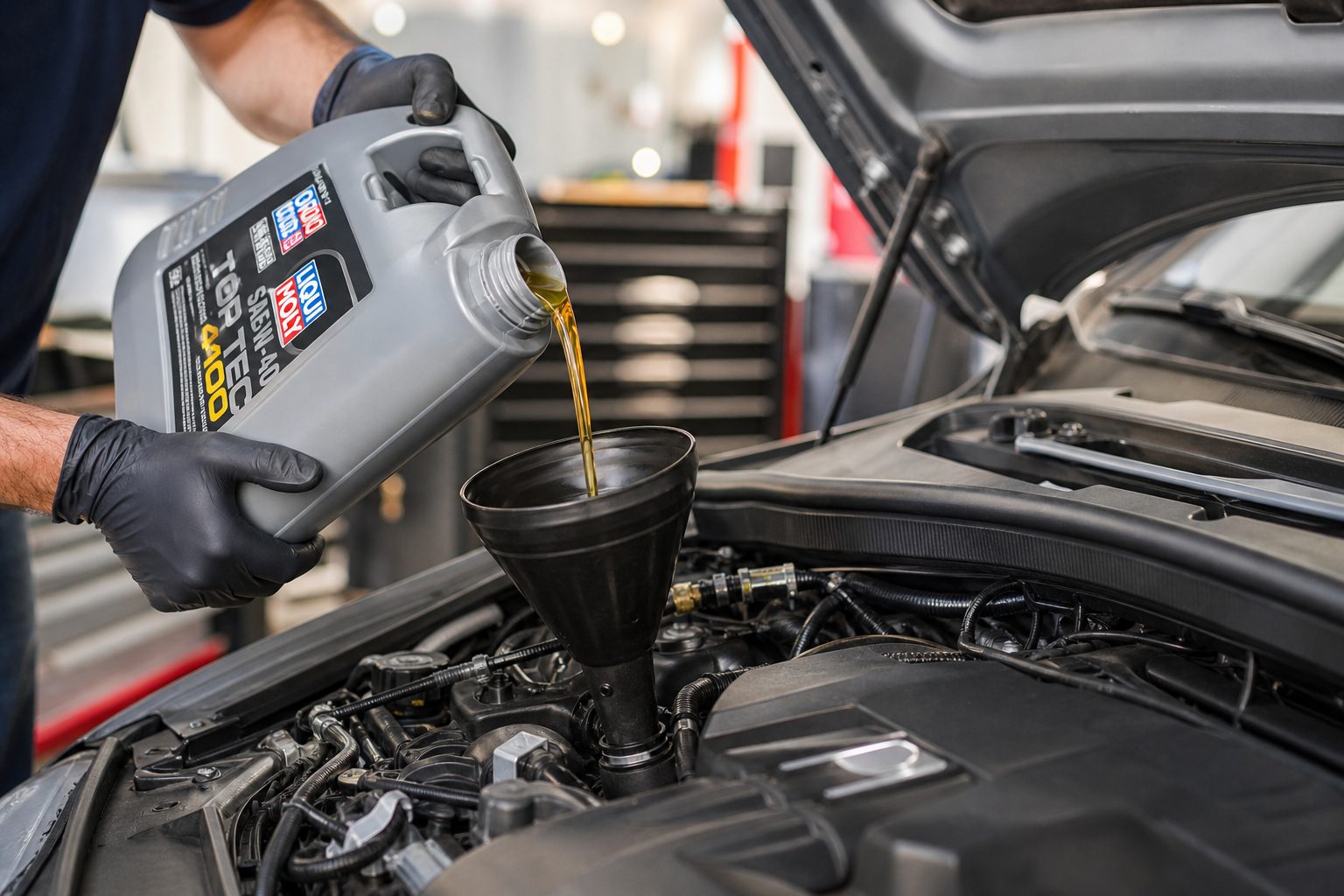
We pull your vehicle's published oil specification before we order anything. A BMW calling for LL-01 full synthetic gets exactly that. A domestic truck approved for a conventional blend gets that instead. The spec drives the choice, not whatever is sitting on the shelf.
Full Oil Drain and Filter Swap
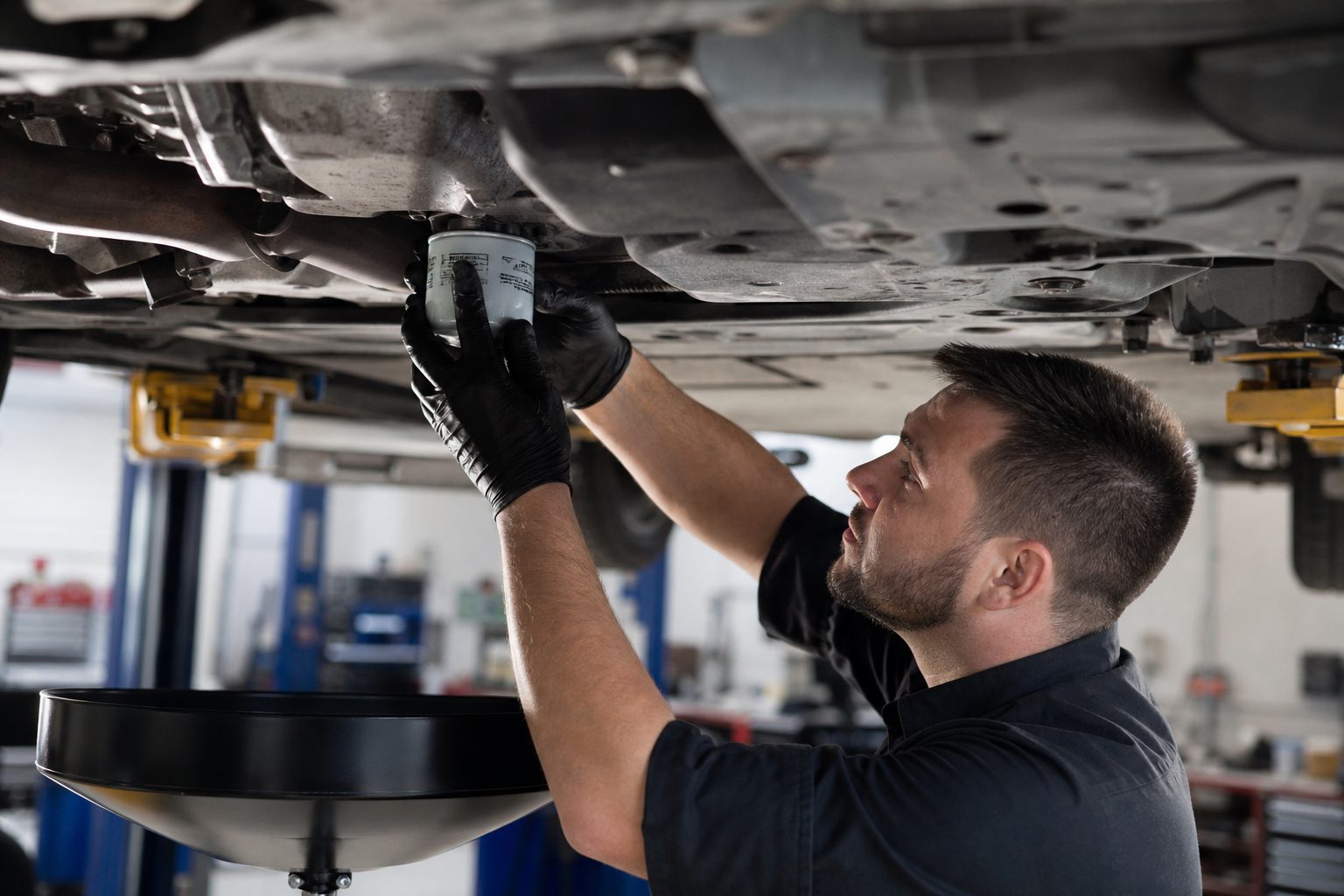
Every visit gets a complete drain and a new filter. A dirty filter left in place defeats the purpose of fresh oil entirely. The old filter traps combustion byproducts and metal particles; leaving it in means those contaminants circulate right back through your engine.
Drain Plug and Gasket Check
We inspect the drain plug and crush washer every time. A deformed or cross-threaded plug creates a slow seep that most drivers never notice until the oil level is dangerously low. Skipping this step is one of the more common causes of oil leak repair calls we see.
Fluid Level Top-Off
Windshield washer fluid, brake fluid, and the coolant overflow reservoir are checked and topped off while the car is on the lift. Our coolant services team flags low levels before they turn into a bigger problem.
Visual Belt and Hose Inspection
We do a visual pass on accessory belts, radiator hoses, and visible wiring. This is not a full diagnostic. It is enough to flag a cracking serpentine belt or a soft radiator hose before either one leaves you stranded.
Service Interval Recommendation
Your next interval is based on your oil type, your actual driving pattern, and manufacturer guidance. Drivers logging heavy commutes are in a severe-duty cycle that shortens intervals. A generic mileage sticker does not account for that. Yours will.
How Our Oil Change Process Works
Step 1: Book an Appointment Online or by Phone
We work by appointment. That means when you arrive, you're not pulling a number and waiting behind six other cars. Your time slot is yours.
Step 2: We Verify Your Vehicle's Oil Specification
Before we touch the drain plug, we pull the manufacturer's oil specification for your exact year, make, and model. A 2019 Audi A4 requires a full synthetic meeting VW 502.00 approval. A 2019 Ford F-150 does not. Those are different oils, and putting the wrong one in either engine is a problem. If you drive a BMW or an Audi, the spec matters more than the price on the board.
Step 3: Drain, Filter, Fill, and Inspect
Old oil out, filter swapped, correct oil to the correct level. While the car is on the lift, we do a visual pass on belts, hoses, and visible fluid reservoirs. Part of our preventative maintenance approach is catching the small things before they become the expensive ones.
Step 4: Review and Drive
We walk you through anything we notice. You get the next recommended service interval. Then your keys, no pressure, no uninvited add-ons.
Signs It's Time for an Oil Change in Atlanta
Most drivers search for an oil change near me only after something's already gone wrong. Truth is, your car usually tells you well before that point. Here are five things you can check yourself, no tools required.
Oil Change Reminder Light
If the oil life monitor or oil pressure warning light is on, you are already past due. Short city trips are hard on oil because the engine never fully warms up, which accelerates degradation faster than mileage alone suggests.
Dark and Gritty Dipstick
Pull the dipstick and wipe it on a white cloth. Fresh oil is amber and translucent. Black, gritty oil means the additive package is spent. It is no longer protecting the engine the way it should.
Ticking or Knocking at Startup
A ticking or knocking sound in the first few seconds after startup means the oil is too thin, too dirty, or too low to pressurize the lifters quickly. That is metal moving without lubrication. It stops being a cheap fix the longer you wait, and engine repair costs significantly more than an oil change.
Burning Smell Under the Hood
A burning smell after the engine warms up often means oil is leaking onto a hot exhaust component. Bring it in. We can spot a developing oil leak during a routine oil change visit before it becomes a bigger problem.
Engine Running Hotter Than Usual
Oil carries heat away from internal components. Degraded or low oil causes temperature to climb. If your temp gauge reads higher than normal on your commute, check oil condition first, then consider whether your coolant services are also due.
Why Driving Conditions Affect Your Oil Faster
Heavy traffic and short trips break oil down ahead of the sticker interval. Understanding these pressures helps you stay ahead of costly repairs.
Severe-Duty Commuting, Not Mixed Driving
The manufacturer's oil change interval printed on your windshield sticker assumes mixed driving: some highway miles, some city miles. Daily driving rarely looks like that. Heavy traffic can crawl for hours every weekday, and low-speed, high-RPM idling in that traffic is classified as a severe-duty driving cycle, and it degrades oil significantly faster than the interval on that sticker accounts for. The mileage number stays the same. The oil protection does not.
Engine Load and High Mileage
Hard acceleration and repeated braking in city driving put extra mechanical load on the engine. High-mileage vehicles feel this more acutely because worn piston rings allow more combustion gases to pass the rings and contaminate the oil. If that load goes unaddressed, the cost shows up in places that don't look connected to an oil change, including engine repair that could have been avoided.
Moisture, Scale, and Heat Stress
Moisture matters too. Short cold-start trips allow moisture to enter through the PCV (positive crankcase ventilation) system and mix with oil, reducing its viscosity and lubricating ability. Mineral content in coolant can contribute to scale buildup inside cooling passages, which raises engine operating temperatures and puts additional thermal stress on your oil. If you notice your temperature gauge running higher than usual, that's worth a look at coolant services alongside your next oil change.

Why Atlanta Drivers Choose Blue Ridge Automotive for Oil Changes
We Know What Your Car Actually Takes
A BMW 3 Series requires BMW LL-01 approved long-life synthetic. A domestic pickup may take conventional 5W-30. We verify your car's exact oil specification before anything is ordered, not after the drain plug is already off. That's the level of detail you get with our BMW repair and service, and it applies to every make we work on.
The vehicle mix we see daily runs from early-2000s domestic trucks to late-model German imports. Spec knowledge across that entire range is what separates a shop that does this right from one that grabs whatever's on the shelf.
Transparent Pricing Before We Start
You know the price before the drain plug is touched. No surprise line items after your car is already on the lift. The quote covers the correct oil volume and grade for your vehicle plus the right filter, so a European long-life service and a domestic truck oil change are each priced for what they actually take.
Every oil change includes a multi-point inspection, and anything we find gets reported as a recommendation with a price, never as work already performed. If your car does not need something yet, we tell you when to expect it instead of selling it today, with the mileage or month it will likely come due.
Attentive Service, Every Visit
Our service advisors have built a 4.9-star rating across 1,000+ reviews by doing the straightforward thing: explaining what your car needs and why, in plain language, every time. Drivers keep coming back because the experience is consistent. The same advisors see the same cars year after year, so your service history informs what gets checked next rather than starting from scratch each visit. If a filter, wiper, or fluid is due, you hear the mileage it came due at and the price to handle it, never a surprise line on the invoice. Schedule online or stop by our shop.









Vehicle Brands We Service
From Asian reliability to American work-ready performance, our ASE-certified technicians service every major make. Pick your brand to see model-specific repair details.
































Our Car Repair Shop Locations
We handle oil changes and automotive repair for drivers across the Atlanta region. Wherever you're located, we're close by and ready to help.
Book Your Oil Change at Blue Ridge Automotive
Your oil is either protecting your engine right now, or it is not. Scheduling is straightforward: call us or book online, and we will tell you exactly what oil your vehicle requires and the right interval for how you drive. If your car needs preventative maintenance beyond the oil change, we say so plainly and explain why. Ready to stop guessing whether your oil is still doing its job? Book your oil change today and get a straight answer. Call us today at (404) 266-1699.
Frequently Asked Questions