
Why a Professional Car Diagnostic Test Beats a Handheld Code Reader Every Time in Atlanta
Sharing this:
The check engine light comes on. You drive to the parts store, plug in the handheld reader they lend out for free, and walk away with a code like P0420 and a generic description: "Catalyst System Efficiency Below Threshold." A quick search tells you that probably means a bad catalytic converter, so you buy one, install it, and the light comes back on two days later. Now you've wasted money and still have the same problem.
This is the code-reader trap, and it plays out thousands of times a week across Atlanta. A handheld reader shows you a fault code. A professional car diagnostic tells you what's actually causing that code on your specific vehicle, under your specific driving conditions, and what it'll actually take to fix. Those are two very different things, and understanding the gap between them is the difference between throwing parts at a problem and actually solving it.
What a Handheld Code Reader Actually Does
A basic OBD2 code reader does one job: it pulls stored diagnostic trouble codes from the engine control module and displays them on a screen. Plug it in, turn the key to accessory position, hit the read button, and you get a string of P-codes, B-codes, or C-codes, each followed by a generic description. Some readers can also clear codes, turn off the check engine light, and display basic freeze-frame data from the moment the code is set.
That's genuinely useful for certain situations. If you want to confirm whether a check engine light is serious or just a minor evap leak before a road trip, a code reader gives you a quick answer. If you've finished a repair and want to verify the system is no longer throwing the fault, it handles that too. Entry-level readers do this basic function well enough for anyone who knows what they're looking for.
What they can't do is tell you why the code set, whether other systems are contributing to it, or whether the first recommended part is actually the problem. For that, you need a different class of tool entirely.
What a Professional Diagnostic Scanner Actually Does
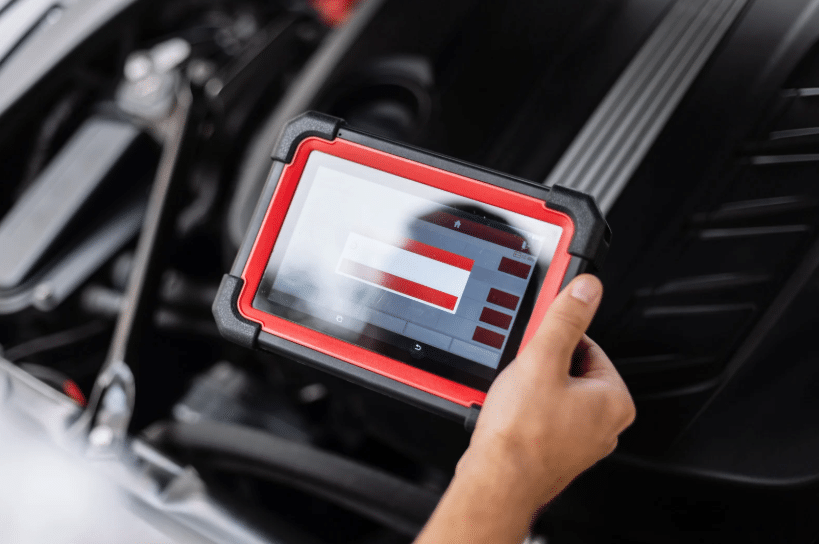
Professional diagnostic scanners used in a shop setting are a different category. They connect to the vehicle the same way through the OBD2 port, but they communicate with every control module on the car, not just the engine. They pull stored codes, pending codes, and history codes, along with manufacturer-specific subcodes that generic readers can't access at all. They display live data streams from dozens of sensors simultaneously, capture freeze-frame data across multiple modules, and offer bidirectional control to command components to perform specific actions on demand.
A tool like the Autel MaxiSys, Snap-on Modis, or Bosch ADS series runs several thousand dollars before software subscriptions, and the training to use one effectively takes years. That investment is what separates a technician who can actually diagnose a problem from a reader that can only report symptoms.
The practical difference is staggering. A handheld reader tells you the car has a fever. A professional scanner tells you the fever is being caused by an infection in a specific location, measures the severity, and lets the technician verify the diagnosis before anyone touches a wrench.
Why One Code Often Has Ten Possible Causes
Let's stay with that P0420 example. The code officially means the oxygen sensor after the catalytic converter is reading oxygen content too similar to the sensor before the converter, which suggests the catalyst isn't doing its job. A code reader delivers that information and lets you draw your own conclusions.
A professional diagnostic looks at the full picture. The actual root cause of a P0420 could be a genuinely failed catalyst. It could also be a faulty downstream oxygen sensor giving bad readings, an upstream sensor that's slow to respond, an exhaust leak before the converter that's throwing off the readings, a misfire that's contaminating the catalyst over time, a rich or lean fuel trim condition that's overloading the converter, an EVAP purge valve issue, or even a software calibration problem.
A technician with professional tools compares oxygen sensor voltage graphs in real time, watches fuel trims across different load conditions, pulls misfire counts per cylinder, and tests the catalyst's response to commanded conditions. That process routinely saves drivers from replacing an expensive catalytic converter when the real issue was a much cheaper oxygen sensor. Our breakdown of what diagnostic trouble codes mean covers how codes translate to actual repair decisions.
Live Data: The Biggest Difference Most Drivers Don't Know About
Live data is where professional diagnostics genuinely leave code readers behind. A shop scanner can display real-time readings from every sensor the vehicle monitors, updating several times per second. Coolant temperature, intake air temperature, mass airflow grams per second, short-term and long-term fuel trims on each bank, oxygen sensor voltages, throttle position, cam and crank timing offsets, transmission fluid temperature, turbocharger boost pressure, and dozens more.
Watching live data under real operating conditions catches problems that stored codes never catch. An intermittent misfire that only happens above 55 mph under load won't always set a code, but it will absolutely show up in the data stream if a technician knows where to look. A slow-responding oxygen sensor that's still technically within spec will drift on the graph in ways a human eye can spot immediately.
This is also how shops diagnose "phantom" problems where the check engine light isn't even on, but something about the car feels off. A rough idle, a hesitation on acceleration, a fuel economy drop that doesn't match mileage. Live data reveals what the car's computer is doing in real time, which is the only reliable way to troubleshoot drivability issues that don't trip a fault code.
Bidirectional Control: Commanding the Car to Prove the Fault
Bidirectional control is the capability that no handheld code reader has. A professional scanner can send commands to the vehicle's control modules and make components perform specific actions on demand. This turns diagnosis from guessing into testing.
The practical scenarios are everywhere. If a cooling fan isn't coming on when the engine gets hot, a technician can command the fan to run from the scanner. If it runs, the fan and its wiring are fine, which means the problem is in the temperature sensor or the control logic. If it doesn't run, the problem is in the fan circuit. Either way, the test takes 30 seconds and eliminates hours of probing with a multimeter.
The same principle applies across the vehicle. Fuel injectors can be cycled individually to verify which cylinder has a weak injector. EVAP systems can be pressure-tested by commanding the purge and vent valves closed. ABS pumps can be activated for proper bleeding after brake service, which is why quality brake services on modern vehicles require a professional scan tool to complete correctly. Transmission solenoids can be commanded to activate to verify whether shift issues are electrical or mechanical in nature, which matters greatly when deciding between a simple sensor replacement and full transmission repair.
Access to Every Module, Not Just the Engine
Most basic OBD2 code readers only communicate with the engine control module. That's where the generic emissions-related codes live, and it's what federal OBD2 regulations require manufacturers to expose through the standard port.
Modern vehicles have anywhere from 30 to more than 100 individual control modules. The ABS module handles anti-lock braking and stability control. The SRS module controls airbag deployment. The body control module handles lights, locks, wipers, and windows. The transmission has its own module, as does the HVAC system, the tire pressure monitoring system, the adaptive cruise control, the lane-keep system, and on newer vehicles, the infotainment and telematics systems.
When a problem lives in one of these modules, a basic code reader never sees it. A dashboard warning light might be active for a week while the handheld reports "no codes found" because it isn't communicating with the module that has the actual fault. Professional scanners access every module individually, which is the only way to diagnose issues outside the engine system accurately. This is especially true for the kinds of drivability and emissions problems covered in our article on 12 common engine problems identified through diagnostics.
Why Code Reader Misdiagnosis Costs More Than a Real Diagnostic
Let's do the math honestly. A professional diagnostic appointment in the Atlanta area is a flat-rate service depending on complexity. That gets you targeted testing, written findings, and a repair estimate based on evidence rather than guesswork.
The alternative looks like this. Free scan at the parts store returns a P0171 lean condition code. The internet says it could be a MAF sensor, so you buy a new sensor and install it. Light comes back on a week later. Now you're thinking of a vacuum leak, so you buy a smoke machine or take it to a shop just to find a small vacuum hose is cracked — all that time and expense to fix what a professional diagnostic would have identified in 45 minutes.
That pattern repeats constantly, and it gets worse on expensive parts. Replacing an oxygen sensor, a catalytic converter, a coil pack, or an injector because a code "suggested" it is one of the most common ways drivers overspend on their cars. The guide on why regular diagnostics can help prevent major repairs walks through the specific scenarios where catching problems early with real diagnosis avoids catastrophic costs later.
When a Handheld Code Reader Is Actually Useful
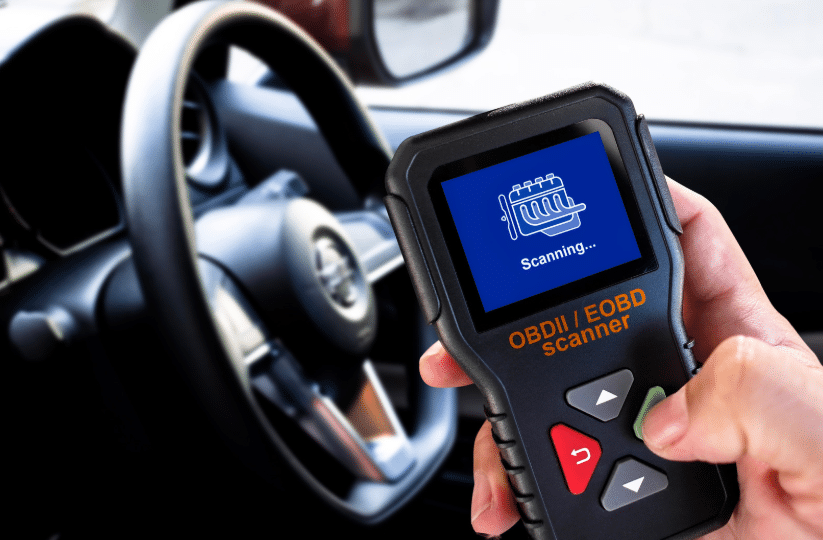
Code readers aren't worthless. They're just the wrong tool for diagnosis. Where they genuinely help is in quick verification scenarios.
If the check engine light comes on mid-road trip, a reader tells you whether the code is a serious drivability issue or a minor fault you can safely address when you get home. If you've just finished a repair, a reader confirms the fault code has cleared and doesn't come back on a drive cycle. If you're shopping for a used car and want a 30-second pass check for stored codes, a handheld gets you that information before you commit time to a full pre-purchase inspection.
For those limited purposes, an inexpensive reader is a reasonable tool to keep in the glove box. What it shouldn't do is substitute for actual diagnosis when you have an ongoing problem. Treating a code as a diagnosis instead of a starting point is the single most common reason drivers pay for repairs that don't fix anything.
What a Professional Diagnostic Appointment Looks Like at a Shop
At a well-equipped independent shop, a proper diagnostic appointment starts with an intake conversation. When does the problem happen, at what speeds, under what conditions, with what other symptoms? That interview shapes what the technician scans for first.
The vehicle goes onto a scanner that communicates with every module on board. Stored codes, pending codes, and history codes get pulled and logged. Live data is captured while the engine idles and during a road test that replicates the conditions under which the problem appears. Bidirectional commands confirm whether specific components respond correctly. If needed, additional testing with a multimeter, pressure gauge, compression tester, or borescope fills in what the scanner data suggests.
The result is a written summary of findings with root-cause analysis, not just a list of codes. The estimate that follows is based on what the diagnostic actually proved, which means you're paying for repairs that will solve the problem rather than guesses that might. That evidence-based approach is also what separates routine component replacement from complex engine repair decisions, where the stakes of getting the diagnosis right are significantly higher.
Frequently Asked Questions
How much does a professional car diagnostic cost?
Atlanta shops typically charge a flat diagnostic fee depending on complexity and the vehicle. Some shops apply the diagnostic fee toward repairs if you proceed with the work. That fee reflects real time spent with professional equipment and trained technicians, not just a quick code scan.
Can I just go to a parts store for a free scan?
You can, and it's fine for learning what code is stored. Just understand that a free scan pulls a generic code and nothing else. It doesn't include live data, bidirectional testing, access to modules beyond the engine, or any kind of root-cause analysis. Using that free code to buy parts is where people get into trouble.
Why does the same code mean different things on different cars?
Generic OBD2 codes describe the symptom, not the cause. A P0171 lean code on a Honda Civic often points to a different root cause than the same code on a BMW 328i or a Ford F-150. Each manufacturer has specific subsystems, common failure patterns, and technical service bulletins that a professional scanner and technician account for. Generic codes don't capture that context.
What if the check engine light goes away on its own?
The code usually stays stored in memory for 10 to 40 drive cycles even after the light turns off. A professional scanner can pull these "history" codes and use freeze-frame data to see what conditions caused the fault. Codes that clear themselves are often the start of an intermittent problem that will recur, so getting it scanned while the information is still available is the smart move.
Does a professional diagnostic guarantee the shop will find the problem?
A thorough diagnostic identifies root causes in the vast majority of cases. Truly intermittent problems sometimes require the vehicle to be kept for extended observation or data logging across multiple drive cycles. A reputable shop will communicate clearly when additional time or testing is needed rather than guessing.
How long does a professional diagnostic take?
Most diagnostic appointments take 45 minutes to two hours depending on the complexity of the issue. A straightforward single-system problem wraps up quickly. An intermittent drivability issue that requires a road test plus live data review takes longer. Your shop should give you a realistic time estimate when you schedule.
About Blue Ridge Automotive
Blue Ridge Automotive has been serving Atlanta drivers for years from our Buckhead location, with additional convenient shops in Chamblee at (770) 216-8474, Decatur at (404) 549-9424, and Marietta at (770) 426-4220. Our ASE-certified technicians use professional-grade diagnostic equipment to identify the root cause of drivability issues, warning lights, and unusual noises on Asian, domestic, and European vehicles. Every diagnostic comes with a detailed written report, and every repair is backed by a 24,000-mile, 24-month warranty on parts and labor through TechNet, so you know what you're paying for and what it covers.
Skip the Code Reader Guesswork
If your check engine light is on, or if something about the way your car drives just doesn't feel right, a professional diagnostic is the fastest way to separate the real problem from the symptoms it's showing. Our technicians scan every module, review live data, and provide a written explanation of what we find before any repair work is authorized.
Call (404) 266-1699 or schedule a service online to book your diagnostic appointment at the Blue Ridge Automotive Buckhead location.