
What to Expect When Your CV Axle Fails in Chamblee and How Much It Costs to Replace
Sharing this:
You're pulling out of a tight Chamblee parking spot, cranking the steering wheel hard to the right, and you hear a rhythmic clicking from the front of the car. Click-click-click-click, in time with the wheel rotation. Once you straighten the wheel and accelerate, the noise vanishes. The car drives perfectly fine otherwise.
That's a CV axle telling you it's on borrowed time. Most drivers ignore it for weeks or months because the car still drives, and the clicking only happens during slow, tight turns. By the time it's clicking on a highway on-ramp or vibrating during acceleration, the cheaper repair window has closed and you're looking at a full axle replacement. This post covers what's actually happening inside a failing CV axle, the symptom progression that tells you how far gone yours is, what replacement actually costs in the Chamblee area, and what happens if you ignore the warning signs.
What a CV Axle Actually Does
CV stands for constant velocity. The CV axle is the shaft that transfers power from your transmission (on front-wheel-drive vehicles) or differential (on rear-wheel-drive and all-wheel-drive vehicles) to the wheels. Each axle has two joints. The outer joint sits at the wheel hub and allows the wheel to steer left and right. The inner joint sits at the transmission or differential and accommodates the up-and-down movement of the suspension.
Both joints are precision components packed with grease and protected by a flexible rubber boot called a CV boot or gaiter. The boot's only job is to keep the grease in and contaminants out. As long as the boot stays intact, the joint inside can run for hundreds of thousands of miles. Once the boot fails, the joint is on a countdown to destruction.
Most failures originate at the boot, not the joint itself. This is why catching boot damage early is the difference between a moderate repair and a more expensive one.
How CV Axles Fail (It's Almost Always the Boot)
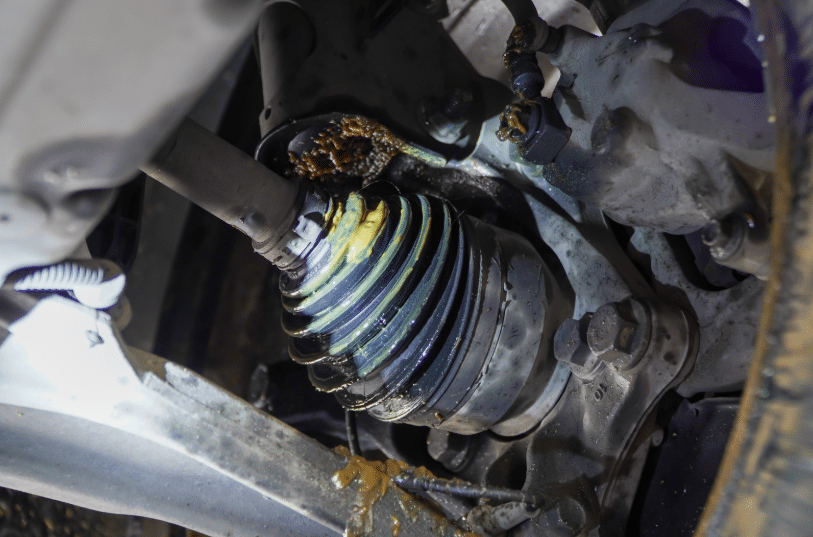
The typical failure sequence starts with a small tear or crack in the rubber boot. The cause might be age and heat-cycling, a stick or piece of road debris, a hard pothole impact that flexes the boot beyond its design limits, or just slow degradation over many years. Once the boot is breached, grease starts slinging out as the joint rotates. Centrifugal force throws the grease across the inside of the wheel and into the wheel well, where you can often see it as dark, oily streaks.
With grease leaving and the joint exposed, dirt and water work their way in. The metal-on-metal contact inside the joint, which was previously cushioned by clean grease, now has contaminants grinding away at the bearing surfaces. Within a few thousand miles of running with a torn boot, the joint develops measurable internal wear. That's when the clicking starts.
A boot caught early, before grease loss damages the joint, can sometimes be replaced on its own for $200 to $400 per side. A boot caught after the joint is already worn means full axle replacement, which runs significantly more. The window between "boot only" and "whole axle" can be just a few thousand miles, which is why catching a torn boot promptly matters so much.
The Symptom Progression Most Drivers Don't Recognize
CV axle failure goes through fairly predictable stages, and recognizing where yours is helps you know how urgent the repair is.
Stage one is a visual symptom. Dark grease appears on the inside of the wheel rim, on the inner sidewall of the tire, or splattered in the wheel well. The car drives normally, but the boot has clearly torn and grease is escaping. This is the cheapest stage to address, often with boot replacement alone if the joint hasn't yet been compromised.
Stage two is the classic clicking or popping noise during slow, tight turns. You'll hear it pulling out of parking spots, doing U-turns, or making sharp turns at low speeds. The noise comes from the side that's failing, often most noticeable when turning toward that side. The joint has begun wearing internally.
Stage three is clicking that happens even during straight-line driving, especially under load. By this point the wear is significant.
Stage four introduces vibration during acceleration. You feel it through the steering wheel or the floor, often most noticeable between 30 and 50 mph. The vibration tends to get worse over time rather than staying constant.
Stage five is a grinding or droning noise that changes with vehicle speed. The joint is severely worn at this point, and replacement is overdue. This is also a stage where the symptoms can be confused with wheel bearing failure, which produces similar noise patterns but for different reasons. A proper diagnostic service distinguishes between them quickly.
Stage six is complete failure. The joint locks up, the axle separates, or the wheel loses power entirely. This usually happens at the worst possible moment, like an on-ramp or a busy intersection.
Front-Wheel Drive vs. Rear-Wheel Drive vs. AWD
Vehicle drivetrain layout determines where your CV axles live and how many you have. Front-wheel-drive vehicles have CV axles on the front wheels. These work the hardest because they both deliver power and steer, which is why front CV axles fail more often than any other type.
Rear-wheel-drive vehicles with independent rear suspension have CV axles on the rear wheels. These typically last longer than front axles because they don't deal with steering angles, but they still wear out eventually.
All-wheel-drive vehicles have CV axles at all four corners, which means more components that can fail and more complexity in diagnosis. Some AWD designs also use additional CV joints in the driveshaft itself. Total parts count can be eight or more CV joints across the drivetrain.
The diagnosis principle stays the same regardless. Listen during turns at low speed, look for grease leaks around the inside of each wheel, and watch for vibration patterns during acceleration. Each side fails independently, so it's normal to need replacement on one side without the other being immediately due.
Boot Replacement vs. Full Axle Replacement
If you catch a torn CV boot early enough, before the joint has accumulated internal wear, boot-only replacement is a legitimate option. The procedure involves removing the axle, replacing the boot, repacking the joint with fresh grease, and reinstalling. Costs run $200 to $400 per side at most shops.
Once the joint is clicking, however, boot replacement alone is throwing good money after bad. The internal damage is already done, and a new boot won't restore the worn joint surfaces. At that point, full axle replacement is the right move. Most modern shops actually skip the boot-only repair on anything but the freshest tears because the labor cost approaches the full-axle cost anyway, and a freshly rebuilt boot on a marginal joint often fails within a year.
The most economical approach is generally to inspect for boot damage at every routine scheduled maintenance appointment, catch tears the moment they appear, and replace the boot before the joint is damaged. Many shops will check CV boots for free during oil changes if you ask.
What CV Axle Replacement Actually Costs
For mainstream Asian and domestic vehicles in the Chamblee area, full CV axle replacement typically runs $300 to $700 per side including parts and labor. Aftermarket axle assemblies cost $80 to $200 per side, OEM units run $150 to $300, and labor takes 1.5 to 3 hours at $130 to $180 per hour at typical independent shop rates.
European luxury vehicles run higher. BMW, Mercedes, Audi, and similar makes typically land between $500 and $1,200 per side because OEM parts cost more, the labor times are longer, and some designs require specialty tools or additional disassembly. Some all-wheel-drive applications and high-performance vehicles run higher still.
Doing both sides at the same time usually costs less than 2x a single side because some of the labor overlaps. If a shop quotes one side now and you suspect the other is also marginal, asking about a both-sides quote often produces a better total number than two separate visits would. Quality of replacement parts also matters, and the broader OEM vs. aftermarket parts tradeoffs apply here as much as anywhere else.
Why Both Sides Often Get Replaced Together
CV axles on a vehicle have shared a common life. Same age, same mileage, same Georgia heat, same potholes. If one side has failed from accumulated wear, the other side is statistically likely to be close behind. On vehicles past 100,000 miles, doing both at once is often the smarter approach even if only one is currently making noise.
This isn't an upsell. It's the same principle as replacing brake pads on both sides of an axle even if only one is worn. Doing it together saves on repeat shop visits and ensures balanced performance and wear going forward. That said, it's a customer decision. A shop should explain the case for both sides clearly and respect your choice if you want to do one at a time.
If your vehicle is under 80,000 miles and only one side has failed (often from a specific impact rather than gradual wear), single-side replacement is usually fine.
What Chamblee Conditions Mean for CV Axle Life
Heat is hard on CV boots. The rubber compounds used for boots are designed to handle moderate temperature ranges, and Chamblee's long, hot summers age them faster than the same boots would age in a cooler climate. Boots that should last 10 to 15 years often crack at 7 to 9 years here, especially on vehicles that spend a lot of time idling in traffic with hot engine bay temperatures soaking into the underbody.
Pothole hits and rough road surfaces stress the joints themselves. Even when boots stay intact, repeated impacts on Buford Highway, Peachtree Industrial, and I-285 transfer shock through the suspension into the CV joints. Combined with constant steering inputs from stop-and-go traffic, Chamblee-driven CV axles see harder service than the same axles in a rural commuter pattern. Routine steering and suspension repair inspections often catch CV axle issues alongside other suspension wear that compounds the same way.
The practical effect is that Chamblee CV axles tend to fail at the shorter end of their typical lifespan. Plan accordingly, and pay attention to early warning signs rather than expecting maximum-spec longevity.
What Happens If You Drive on a Failing Axle
The clicking gets worse over time, but the bigger risk is sudden joint failure. A CV joint that's been clicking for six months can lock up entirely under heavy load, like a hard acceleration onto the highway. When that happens, the wheel can lock, the axle can twist or break, and in the worst case the whole assembly can separate from the vehicle.
A separated axle on a front-wheel-drive vehicle means immediate loss of power to that wheel. The car often pulls hard to the side as the failed axle binds, and on a busy road, that pull can be dangerous. You'll be looking at a tow bill, possibly damage to the transmission output shaft if the inner joint separated violently, and a much higher repair cost than the original axle replacement would have been.
There's also the simple matter of being stranded. A clicking axle that fails on I-285 during rush hour leaves you fighting traffic with a vehicle that won't accelerate properly. None of that needs to happen if the axle gets replaced when it first starts clicking.
Frequently Asked Questions
How long can I drive with a clicking CV axle?
Once you're hearing clicks during turns, you typically have weeks to a few months before the noise progresses to clicking during straight driving and then to vibration. Some drivers go longer, but the failure can also progress quickly under heavy use. The smart move is to schedule replacement within a few weeks of first noticing the clicking, before it becomes a roadside emergency.
Can I just replace the boot if it's torn but not clicking yet?
Yes, if the joint is still healthy. The challenge is that there's a narrow window between "torn boot, healthy joint" and "torn boot, joint damage already done." A technician can pull the boot back, inspect the joint condition, and tell you whether boot-only replacement makes sense or whether the joint is already past saving. Acting fast after spotting a torn boot is what makes the boot-only repair viable.
What's the difference between inner and outer joint failure?
Outer joint failure typically produces clicking during turns at low speed. Inner joint failure typically produces vibration during acceleration in a straight line. Both ultimately require axle replacement, but the symptom pattern helps a technician confirm which joint is the source. Most aftermarket and OEM replacement axles include both joints as a single assembly, so the distinction is mainly diagnostic.
Do I need OEM CV axles or is aftermarket okay?
Quality aftermarket CV axles from reputable brands like GSP, Cardone Reman, or SurTrack are generally fine for daily driver applications. Bargain-bin axles, often the absolute cheapest options at parts counters, frequently fail within 20,000 miles and aren't worth the savings. For European vehicles, performance applications, or all-wheel-drive vehicles where geometry tolerances are tighter, OEM is often the safer choice.
How long does CV axle replacement take?
A single-side replacement typically takes 1.5 to 3 hours of shop time. Both sides at the same visit usually wrap up in 3 to 5 hours total. European luxury vehicles can run longer if the design requires removing additional components for access.
Will a bad CV axle damage my transmission?
Usually no, but it can happen in extreme failure scenarios. If the inner CV joint separates violently, the resulting impact can damage the transmission output shaft, the differential, or the transmission case. This is rare but it's another reason not to drive on a severely failing axle. The chain of consequences from a small repair deferred can extend into needing transmission repair, which is dramatically more expensive than the axle replacement would have been.
About Blue Ridge Automotive
Blue Ridge Automotive has served Chamblee drivers since 2010 from our Chamblee location, with additional convenient shops in Buckhead (Atlanta), Decatur, and Marietta. Our ASE-certified technicians inspect CV boots and joints as part of routine service, distinguish between CV axle issues and similar-sounding problems through hands-on diagnosis, and replace axles correctly using the right parts for your specific vehicle. We service Asian, domestic, and European vehicles with the same attention to detail, and every job is backed by a 24,000-mile, 24-month warranty on parts and labor through TechNet.
Hearing Clicks When You Turn?
That sound isn't going away on its own, and waiting only makes the repair more expensive. A quick inspection identifies whether you're dealing with a torn boot caught early, a failing joint that's ready for axle replacement, or something else entirely that just sounds similar. Our technicians can put your vehicle on the lift, inspect both sides, and quote an honest repair before any work begins. A good companion service is a full suspension check, since CV axle issues often pair with other suspension wear worth catching at the same time.
Call (770) 216-8474 or schedule a service online to book your CV axle inspection at the Blue Ridge Automotive Chamblee location.