

What Every Marietta Driver Should Know About the Parts of an Exhaust System

Sharing this:
Most drivers think of the exhaust system as "the muffler." That's the part you can see, the part that makes the noise when it fails, and the part you're vaguely aware costs money to replace. But the muffler is just one piece of a much larger system that starts at the engine and runs the full length of the car. Every component in that chain plays a role in emissions, fuel economy, engine performance, and safety.
Understanding what each part does, how it fails, and what symptoms point to which component turns exhaust repair from a mystery into something you can actually reason about. This guide walks through every major part of an exhaust system, what it's there for, and what warning signs mean trouble is coming. Whether you hear a new rumble under the car or you've just been told you need "exhaust work," this is what every Marietta driver should know before walking into a shop.
Why the Exhaust System Deserves More Attention Than It Gets
The exhaust system does three things at once, and all three matter. It routes hot combustion gases safely away from the cabin. It cleans those gases before they reach the atmosphere. And it manages backpressure in a way that keeps the engine running efficiently. A failure in any one of those jobs shows up as poor performance, failed emissions, reduced fuel economy, or in the worst case, carbon monoxide in the passenger compartment.
Georgia requires annual emissions testing in 13 metro counties including Cobb, where Marietta sits. An exhaust system that can't properly process combustion byproducts means a failed test and no tag renewal. That's a registration problem before it's a repair problem, which is why understanding the system matters even when everything seems fine. Regular exhaust services catch wear before it turns into a failed inspection.
Exhaust Manifold (or Headers): Where It All Starts
The exhaust manifold bolts directly to the cylinder head and is the first component combustion gases contact with after leaving the engine. Its job is to collect exhaust pulses from each cylinder and funnel them into a single pipe that feeds the rest of the system. Most factory manifolds are cast iron, chosen for its ability to handle combustion temperatures that can spike past 1,300 degrees Celsius.
Performance-oriented vehicles and aftermarket upgrades often use tubular steel headers instead. Headers give each cylinder its own individual runner of equal length, which reduces backpressure and improves scavenging. That's a performance gain on the dyno, but tubular headers also crack more easily than cast iron when subjected to thermal cycling over years of use.
Cracked manifolds and failed gaskets are the most common failures at this end of the system. The symptom is a ticking or hissing sound from the engine bay that's loudest at cold start and often fades as the manifold heats up and expands. A leak here sends raw exhaust into the engine compartment, throws off oxygen sensor readings, and often damages nearby heat shields and wiring.
Oxygen Sensors: The System's Eyes
Oxygen sensors screw into the exhaust system at specific points and measure how much unburned oxygen remains in the exhaust stream. Modern vehicles typically have at least two sensors per exhaust bank: one upstream of the catalytic converter and one downstream. The upstream sensor tells the engine control module whether the air-fuel mixture is rich or lean so the computer can adjust fueling in real time. The downstream sensor monitors catalyst efficiency by comparing pre- and post-converter oxygen levels.
When an oxygen sensor fails or slows down, the engine runs inefficiently. Fuel economy drops noticeably, emissions rise, and the check engine light often comes on with codes in the P0130 to P0175 range. A slow-responding sensor can still pass basic tests but push fuel trims out of normal range in ways only a proper diagnostic service can catch with live data.
Sensors degrade over time from contamination and heat exposure. Most last 60,000 to 100,000 miles under normal conditions, shorter on high-mileage vehicles with oil consumption or coolant leaks. Replacement is usually straightforward, and the guide on O2 sensor replacement cost covers what to budget for the job.
Flex Pipe: The Flexible Joint
Transverse-mounted engines rock back and forth on their mounts during acceleration and deceleration. If the exhaust system were one rigid piece, that movement would crack pipes and loosen connections within months. The flex pipe solves the problem. It's a short section of braided stainless steel mesh over an interlocking inner liner that allows flex without leaking.
Flex pipes wear out. The braid corrodes, the inner liner cracks, and eventually the joint starts leaking exhaust just downstream of the manifold. The telltale symptom is a loud rumble or roar that gets worse under acceleration and quiets when you let off the throttle. Some drivers mistake it for a muffler problem because the noise is dramatic, but the source is usually at the front of the exhaust, not the back.
Replacing a flex pipe often requires cutting and welding in a new section, which is why this job belongs in a shop with the right equipment rather than a driveway. A well-executed weld repair lasts years. A bad one fails quickly and sometimes takes the catalytic converter with it.
Catalytic Converter: The Emissions Workhorse
The catalytic converter is where the exhaust system does its most important chemistry. Inside the converter's ceramic honeycomb substrate, a thin coating of platinum, palladium, and rhodium catalyzes chemical reactions that convert harmful hydrocarbons, carbon monoxide, and nitrogen oxides into less harmful carbon dioxide and water vapor. Modern converters work at 90%-plus efficiency when they're in good condition.
Converters fail for a handful of reasons. Ignition misfires dump raw fuel into the exhaust, which ignites inside the converter and melts the substrate. Coolant leaking into the cylinders from a bad head gasket coats the catalyst and kills its ability to do chemistry. Extended misfires from bad coils, plugs, or injectors slowly poison the substrate. A failing converter typically triggers a P0420 or P0430 code, which our guide on diagnostic trouble codes explains in detail.
Converter theft has also become a serious issue across the metro region. The precious metals inside are valuable, and thieves with sawzalls can remove a converter in under two minutes. Replacement cost varies significantly depending on the vehicle, and insurance often covers theft-related losses. If you park outside regularly around Marietta, an anti-theft cage or etched serial number adds a meaningful layer of deterrence.
Resonator: The Unsung Component
Many exhaust systems include a resonator between the catalytic converter and the muffler. It's a second, smaller muffler-like chamber whose specific job is to cancel particular frequencies that would otherwise come through as drone or boom at cruising speeds. Without a resonator, a car can be technically quiet by muffler measurement but still have a fatiguing cabin noise at 70 mph.
Resonators are easy to overlook because they rarely fail dramatically. They rust through quietly over five to ten years, usually from the inside out as condensation accumulates and eats through the shell. The first symptom is often a subtle change in exhaust tone rather than a loud noise. By the time it sounds like a failure, the resonator is usually split wide open.
Not all vehicles have a resonator. Some rely on muffler design alone to control both volume and frequency. But if your car does have one and it rusts through, replacement usually means cutting out the old section and welding in a new piece.
Muffler: Where the Noise Goes to Die
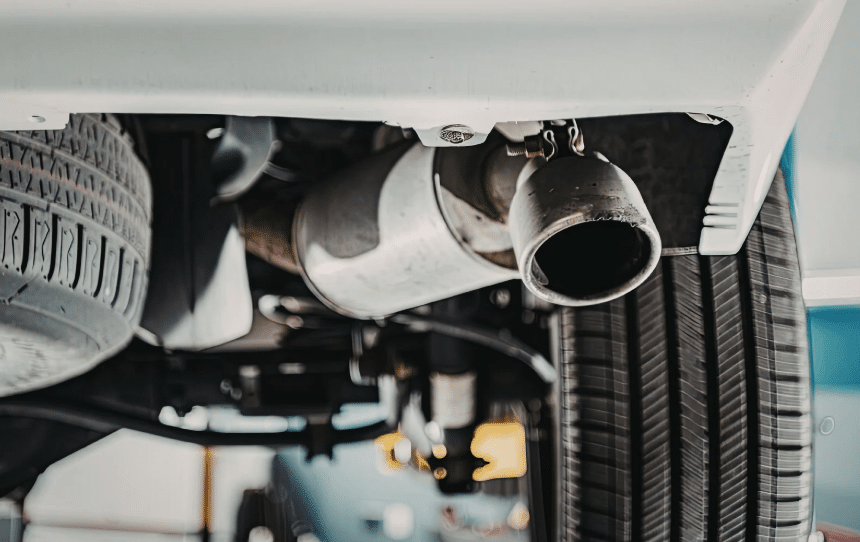
The muffler sits near the rear of the vehicle and is the component most drivers associate with exhaust work. Inside the shell, exhaust gases pass through a series of baffles, perforated tubes, and sound-absorbing material designed to cancel noise through reflection and interference. Reverse-flow mufflers route gas through a longer, more complex path for quieter operation. Straight-through mufflers prioritize flow over silence and are common on performance vehicles.
Muffler failure almost always starts with rust. Coated steel shells last 5 to 10 years in Georgia's climate, longer if the vehicle sees mostly dry garage storage. Stainless steel mufflers can last the life of the vehicle. The first sign of trouble is usually a louder, deeper exhaust note that grows worse week over week. Eventually a pinhole becomes a crack, and a crack becomes a gaping split.
Short-trip driving accelerates muffler rot because the system never reaches temperatures high enough to evaporate the moisture that combustion produces. Water pools inside the muffler and corrodes it from within. This is one of the areas where scheduled maintenance inspections catch problems early, before a simple muffler replacement turns into a full mid-section job.
Exhaust Pipe and Tailpipe: More Than Just Tubing
The pipes connecting each major component are not generic plumbing. Their diameter, bend radius, and routing are engineered to maintain specific backpressure and flow characteristics. Oversizing exhaust pipe diameter on a factory-designed system reduces gas velocity and can actually hurt performance, especially at low RPM. Undersizing creates backpressure that reduces top-end power and loads the engine unnecessarily.
Standard exhaust pipe is aluminized steel, which holds up reasonably well but eventually rusts at the seams and bends. Stainless steel pipe costs more but lasts decades. The tailpipe is the short final section that extends past the rear bumper and releases treated exhaust into the atmosphere. Pipes are connected with welded joints, flange connections, or clamps, and any of those connection points can become a leak source over time.
Pipes also wear from the outside in thanks to road salt, moisture, and whatever debris gets kicked up during normal driving. Rust usually appears first at the bottom of the lowest-hanging section, then spreads along the pipe from there.
Gaskets, Clamps, and Heat Shields: Small Parts, Big Consequences
Every joint in the exhaust system needs a seal. Gaskets between the manifold and the head, between the manifold and the downpipe, between the converter and the cat-back section, and between section-to-section flanges all keep exhaust contained inside the system where it belongs. Gaskets fail with age and thermal cycling, and a failed gasket produces ticking sounds that many drivers initially mistake for internal engine noise tied to the kind of conditions covered in 12 common engine problems.
Clamps hold the system to the vehicle's underbody through rubber isolators called hangers. When a hanger dry-rots or a clamp rusts through, the exhaust sags or sways on bumps, eventually cracking at the weakest point. A rattle over potholes that goes away at highway speed is almost always a loose hanger or a failing clamp.
Heat shields protect the floor of the car, fuel lines, wiring, and undercarriage components from the extreme heat of the exhaust. When a heat shield rusts loose, it rattles at idle and buzzes at specific RPM ranges, producing noise dramatic enough that drivers often assume something major has failed. The fix is almost always simple: re-secure or replace the shield. Ignoring a loose shield isn't dangerous, but the rattling will drive you crazy long before it stops on its own.
How the System Works Together (And Fails Together)
Exhaust components are interconnected in ways that matter for diagnosis. A misfiring ignition coil dumps raw fuel into the exhaust, which ignites inside the catalytic converter and damages the substrate. A failing oxygen sensor gives the engine computer bad data, which causes the computer to run the fuel mixture too rich or too lean, which then contaminates or overheats the converter. A small leak at the manifold gasket draws unmetered air into the exhaust upstream of the oxygen sensor, which fools the sensor into reporting a lean condition that isn't actually present in the cylinders.
The pattern is consistent. Problems propagate downstream, and replacing the damaged component without fixing the root cause sets up the same failure again. A catalytic converter replaced without addressing the underlying misfire fails within months. An oxygen sensor replaced without repairing the exhaust leak continues reading wrong. This is why thorough diagnosis before major engine repair work saves money and prevents repeat visits.
Warning Signs Something Is Wrong
A louder exhaust note is the most obvious symptom. If your car suddenly sounds more aggressive than it used to, something in the system is leaking before the muffler can do its job. Rattling under acceleration or over bumps points to loose heat shields, broken hangers, or failing flex pipe. A sulfur or rotten egg smell from the tailpipe suggests the catalytic converter isn't processing gases correctly.
Performance and economy changes are subtler but equally telling. Reduced acceleration, harder starting, or a noticeable drop in fuel economy can all trace back to exhaust problems that throw off the engine's fuel management. A check engine light with codes in the P0130, P0171, P0420, or P0430 ranges typically indicates an exhaust-related issue. Failing Georgia emissions is often the final confirmation that something needs attention.
Any of these symptoms warrants an inspection. Most exhaust problems are far cheaper to fix early than late, and a small leak today is a destroyed catalytic converter tomorrow.
Frequently Asked Questions
How long should an exhaust system last?
A factory exhaust system typically lasts 7 to 12 years in Georgia's climate, with stainless components lasting longer than aluminized steel. Short-trip driving, heavy salt exposure, and neglected maintenance all shorten that lifespan. Individual components can fail earlier, especially flex pipes and oxygen sensors.
Can I just patch an exhaust leak instead of replacing parts?
Exhaust tape and epoxy patches are short-term fixes at best. They might hold for a few months on a small crack, but heat cycling and moisture eventually break down every patch. For anything more than a temporary hold until you can get to a shop, proper welding or section replacement is the only durable fix.
Why are catalytic converters stolen so often?
The platinum, palladium, and rhodium inside converters are worth hundreds of dollars to scrap metal buyers, and thieves can remove one in under two minutes with a battery-powered saw. Hybrids and trucks with high ground clearance are the most common targets. Parking in garages, installing anti-theft cages, and etching VIN or phone numbers onto the converter all reduce risk.
Are European exhaust systems different from domestic or Asian systems?
They follow the same basic layout but often use different materials and tighter packaging. European vehicles frequently come with stainless steel from the factory and more complex configurations to meet European emissions standards. Replacement parts often cost more, and specialized knowledge helps, especially on performance-oriented makes.
Does a louder exhaust actually damage anything?
A louder exhaust from an aftermarket muffler on an otherwise healthy system doesn't harm the engine. A louder exhaust from a leak or failed component is a different story, because a leak upstream of the oxygen sensors can cause fuel trim errors, converter damage, and potential carbon monoxide intrusion into the cabin. If the noise is new and unexpected, have it checked.
Will I pass Georgia emissions with a check engine light on?
No. Georgia emissions testing includes an OBD2 readiness check that automatically fails any vehicle with an active check engine light, regardless of what the specific code is. You have to diagnose and resolve the underlying issue, then complete enough drive cycles for the monitors to reset, before the vehicle will pass.
About Blue Ridge Automotive
Blue Ridge Automotive has been serving Marietta drivers for years from our Marietta location, with additional convenient shops in Buckhead/Atlanta at (404) 266-1699, Chamblee at (770) 216-8474, and Decatur at (404) 549-9424. Our ASE-certified technicians handle every part of exhaust repair, from oxygen sensor replacement to catalytic converter installation to full custom welding for performance applications. We service Asian, domestic, and European vehicles with the same level of precision, and every job is backed by a 24,000-mile, 24-month warranty on parts and labor through TechNet.
Hear Something Off Under the Car?
Exhaust problems rarely get better on their own. A small leak grows, a failing converter eventually throws a code, and a loose heat shield just gets louder. Catching the issue early keeps the repair small, and our technicians can inspect the full exhaust system, identify exactly what's wrong, and quote an honest repair before any work begins.
Call (770) 426-4220 or schedule a service online to book your exhaust inspection or repair at the Blue Ridge Automotive Marietta location.