

How Bad Roads in Atlanta Can Throw Off Your Wheel Alignment and What It Costs to Fix

Sharing this:
You're driving home on the connector, you hit a pothole hard enough to make you wince, and the car keeps tracking straight afterward. No warning lights, no dramatic noises, no obvious damage. You forget about it within a few miles. Six months later, you're shopping for new tires because the inside edges of your fronts are bald.
That sequence plays out thousands of times a week across Metro Atlanta. The impact you barely remember is often the moment your alignment shifted just enough to start chewing through tread, dragging on fuel economy, and slowly wearing out suspension components. This post explains what actually happens to your alignment when Atlanta's roads beat up your suspension, what the symptoms look like (including the ones that aren't obvious), and what proper alignment service actually costs versus what skipping it costs.
What Wheel Alignment Actually Means
Wheel alignment refers to three specific suspension angles that determine how your tires meet the road. Toe describes whether the tires point inward or outward when viewed from above. A small amount of toe-in or toe-out is built into most vehicles by design, but anything outside spec causes the tires to scrub sideways as they roll, which wears tread quickly and unevenly.
Camber is the inward or outward tilt of the wheel when viewed from the front. A wheel tilted outward at the top is positive camber. Tilted inward is negative camber. Most vehicles run slightly negative camber to help the tire maintain full contact during cornering. Excessive camber in either direction wears one edge of the tire faster than the rest.
Caster is the angle of the steering axis when viewed from the side. It mainly affects how the steering feels and how the wheel returns to center after a turn. Caster doesn't typically wear tires the way toe and camber do, but it strongly influences whether the car drives stably or feels twitchy on the highway.
All three angles are measured in fractions of a degree. A misalignment of just a quarter degree is enough to cause noticeable tire wear within a few thousand miles. The tolerances are tighter than most drivers realize.
Why Atlanta's Roads Are Particularly Hard on Alignment
Metro Atlanta has well-known issues with road surface quality. The connector through downtown sees enormous traffic volumes and constant patching. Sections of 285 develop new potholes practically overnight after heavy rain. Construction zones along 400, around the Perimeter, and through ongoing infrastructure projects create uneven transitions, dropped joints, and exposed expansion gaps. Older arterial roads through neighborhoods like East Atlanta, Decatur, and parts of Marietta haven't been fully resurfaced in years and accumulate craters along the lines where patches meet original pavement.
Atlanta's freeze-thaw cycles, while milder than northern cities, still expand and contract pavement enough to crack it open along weak seams. Heavy summer storms then wash out those cracks into full potholes. Spring through early summer is peak pothole season here, and AAA data consistently puts the average cost of pothole-related vehicle damage above $400 per incident.
Beyond potholes, the daily reality of Atlanta driving includes hitting curb edges in tight parking situations, dropping wheels into construction patches, and absorbing the cumulative impact of thousands of miles on uneven surfaces. Each of these events doesn't necessarily knock alignment out by itself, but together they shift suspension geometry over time.
What Actually Happens Inside the Suspension When You Hit Something Hard
When a wheel slams into a pothole, the impact force has to go somewhere. The tire flexes first, which is part of why proper inflation matters. The wheel and rim absorb some of the impact, sometimes bending slightly in the process. The suspension components then transfer the remaining force through ball joints, control arm bushings, tie rod ends, struts or shocks, and ultimately into the chassis.
Each of those components has design tolerances for absorbing force. A pothole at 25 mph on a quiet street usually falls within those tolerances. A pothole at 55 mph on the connector can exceed them. Tie rod ends shift slightly. Control arm bushings compress past their elastic limit. Strut tubes can develop micro-bends that don't show up visually. Ball joints take cumulative wear that adds up over many small impacts.
The cumulative effect is alignment angles drifting out of spec. A car that was perfectly aligned a year ago can be a quarter degree out on toe and a half degree out on camber after a year of Atlanta driving without ever being in an obvious incident. That's enough to cause visible tire wear and measurable handling changes, even when nothing feels dramatically wrong. Periodic inspection through proper steering and suspension repair work catches damaged components before they cause secondary problems.
The Symptoms Drivers Notice (and the Ones They Don't)
The obvious symptoms are easy to spot. The car pulls to one side when you let go of the wheel briefly on a flat, straight road. The steering wheel sits off-center even though you're driving straight. There's a vibration through the wheel at certain speeds. These signals usually mean the misalignment is significant or that something is bent.
The less obvious symptoms are where most drivers get caught. Tires that wear unevenly across their tread, with the inside edge or outside edge thinning faster than the center, almost always indicate alignment issues. Tires that don't last as long as the previous set, even with similar driving habits, are another quiet signal. Fuel economy that creeps downward by a mile or two per gallon over a few months can trace back to tire scrub from misalignment. Steering effort that gradually feels heavier than it used to.
Many alignment problems produce no obvious symptoms at all until the tire wear becomes severe. By that point, you've already lost thousands of miles of tire life and possibly stressed other suspension components. This is why annual alignment checks, regardless of incidents, save money over time. Routine tire repair and inspection appointments are good moments to catch alignment drift before it accelerates wear.
How Much Misalignment Actually Costs You (Beyond the Repair)
A poorly aligned vehicle wears tires roughly 30 to 50 percent faster than a properly aligned one. On a set of all-season tires that should last 50,000 miles, that's the difference between needing replacement at 50,000 versus 30,000 miles. A new set of tires for most vehicles runs $600 to $1,200 installed, so the wear acceleration alone can cost hundreds of dollars per year of ownership.
Fuel economy takes a measurable hit. Tires that aren't tracking straight scrub against the road instead of rolling cleanly, which increases rolling resistance. The effect is typically 1 to 3 MPG depending on severity, which adds up across a year of driving in Atlanta where commutes are long.
Suspension components wear faster too. Ball joints, tie rod ends, and control arm bushings all carry extra load when alignment is out, and they fail sooner as a result. A $100 alignment at the right moment often saves $800 to $1,500 in tire and suspension costs over the following year. The math overwhelmingly favors checking alignment regularly rather than waiting until problems are obvious. Our article on signs you need new shocks and struts covers how alignment problems often signal deeper suspension wear that's worth addressing together.
What a Professional Alignment Service Includes
A proper alignment starts before the car ever goes on the rack. A technician inspects suspension components for damage or wear that would prevent alignment from holding. Bent control arms, worn ball joints, loose tie rod ends, and damaged strut mounts all need to be addressed first, because aligning a vehicle with damaged components is wasted money. The alignment will drift back out within weeks.
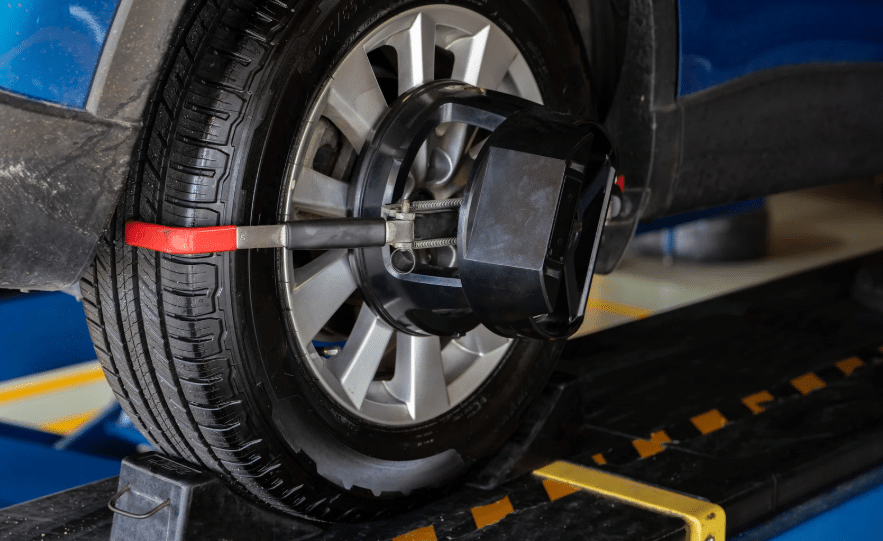
Once the inspection confirms the suspension is healthy enough to align, the vehicle goes on a four-wheel alignment rack. Modern racks use laser or camera-based measurement systems that read all relevant angles on all four wheels simultaneously. The technician compares the measurements to factory specifications, identifies which angles are out, and adjusts what's adjustable on your specific vehicle.
Toe is adjustable on essentially every vehicle through tie rod length changes. Camber is adjustable on many vehicles but not all (some require aftermarket adjustment kits or component replacement). Caster is rarely adjustable on factory front suspensions and usually requires component replacement to correct from damage. After adjustment, the rack re-measures everything to verify the new settings are within spec, and a printout shows before-and-after numbers along with the manufacturer's allowable ranges.
The technician then road-tests the vehicle to verify straight-line tracking and that the steering wheel is centered. The whole process typically takes 60 to 90 minutes including inspection.
What It Costs in Atlanta
A two-wheel (front-only) alignment at most Metro Atlanta shops runs $75 to $100. A four-wheel alignment, which is what modern vehicles with independent rear suspension actually need, runs $100 to $180 for mainstream Asian and domestic vehicles. European luxury vehicles like BMW, Mercedes, and Audi typically run $150 to $250 because of more complex adjustment procedures and tighter tolerances.
If the inspection reveals damaged components that need replacement before alignment can hold, add another $100 to $300 per component for a typical control arm, tie rod end, or strut mount. More extensive suspension work runs higher. The good news is that addressing damaged components and aligning together is far cheaper than aligning the car, having it drift back out within weeks because of the underlying damage, and paying for a second alignment after the parts are finally replaced.
Be cautious of "alignments" that don't include before-and-after printouts or that are quoted suspiciously low. Legitimate alignment service requires a calibrated rack and a trained technician. Shops that don't have either may go through the motions without actually changing anything.
Why Alignment After Suspension Repair Is Mandatory
Any time a suspension component is replaced, alignment shifts. Replacing a control arm changes camber and toe. Replacing a tie rod end changes toe directly. Replacing a strut often shifts camber and caster. Replacing a wheel hub or bearing assembly can affect alignment depending on the design. Putting these parts in without re-aligning the vehicle afterward guarantees accelerated tire wear and unpredictable handling.
This is why reputable shops always include alignment in major suspension repair quotes, or at minimum recommend it strongly. A customer who saves $120 by skipping post-repair alignment usually spends three times that amount on premature tire replacement within a year. Following scheduled maintenance practices that pair alignment with suspension work prevents this exact pattern.
When to Get Checked (Beyond After Pothole Hits)

Annual alignment checks are reasonable for most drivers regardless of whether anything specific has happened. Atlanta roads alone justify it for daily commuters. Beyond the annual baseline, get alignment checked anytime you experience a hard pothole impact severe enough to feel through the steering wheel, anytime you hit a curb hard enough to scrape or jar the wheel, after any front-end suspension repair, after any new tire installation (because new tires reveal alignment issues that worn tires masked), and any time you notice symptoms like pulling, off-center steering, or uneven tread wear.
Alignment is also worth checking when you've just bought a used vehicle, especially if there's no record of when alignment was last performed. The previous owner's driving habits and pothole encounters are unknown, and starting from a verified baseline lets you preserve the new tires you may have just installed. Our breakdown of 4 tire rotation symptoms covers complementary tire care that pairs well with alignment service.
Frequently Asked Questions
How do I know if a pothole knocked my alignment out?
Sometimes you feel it immediately. The steering wheel sits off-center, the car drifts to one side, or there's a new vibration. Often, though, alignment damage from a pothole produces no immediate symptoms at all and only shows up months later as uneven tire wear. If you hit a pothole hard enough to make you wince, getting alignment checked within the next few weeks is the smart move regardless of how the car drives afterward.
Is a two-wheel alignment ever enough?
On older vehicles with solid rear axles, sometimes yes. On most modern vehicles with independent rear suspension, no. The rear wheels affect overall vehicle tracking, and rear toe issues can cause front tire wear that no amount of front-only alignment will fix. When in doubt, four-wheel alignment is the safer and more thorough choice.
Can I drive long distances with bad alignment?
You can, but you'll wear tires fast and your car will fight you the whole way. Severe misalignment can also stress steering and suspension components in ways that lead to bigger problems later. For a road trip across the country, get the alignment checked first. For a quick errand, you'll be fine but plan to address it soon.
How long does an alignment take?
Most alignments take 60 to 90 minutes including inspection, measurement, adjustment, and verification. If suspension components are found to be damaged during the pre-inspection, the appointment can extend significantly to allow for repairs before alignment proceeds.
Why does my alignment keep going out shortly after each service?
This is almost always a sign of an undiagnosed worn or damaged suspension component. A worn ball joint, loose tie rod end, sagging strut, or bent control arm will let alignment drift back out within weeks of being set. A proper diagnostic service inspection identifies the underlying issue so the alignment can actually hold.
Do new tires require an alignment?
Not strictly required, but strongly recommended. Worn tires often mask alignment issues by patterns of wearing that compensate for slight misalignment. New tires have uniform tread and reveal those issues immediately. Aligning when you install new tires preserves the investment and prevents repeating the wear pattern that wore out the previous set. Our overview of why a suspension check matters covers the broader case for catching these issues at tire installation time.
About Blue Ridge Automotive
Blue Ridge Automotive has served Metro Atlanta drivers since 2010, offering honest, reliable vehicle repair and maintenance across four convenient locations in Buckhead, Chamblee, Decatur, and Marietta. Our ASE-certified technicians perform four-wheel alignment service with full inspection of suspension components, calibrated alignment racks, and printed before-and-after reports for every appointment. We service Asian, domestic, and European vehicles with the same precision, and every alignment is backed by our standard warranty through TechNet so the work we do comes with real coverage.
Atlanta Roads Won't Get Easier on Your Tires
If you've hit a pothole that made you wince, noticed your tires wearing unevenly, or felt your steering wheel sitting off-center, the alignment check is the cheapest way to find out what's going on. Catching alignment issues early extends tire life, improves fuel economy, and prevents the cascade of suspension wear that follows untreated misalignment.
Call (404) 266-1699 or schedule a service online to book your wheel alignment at the Blue Ridge Automotive location nearest you.