

Why Worn Spark Plugs in Decatur Cost More Than Just the Replacement Fee
Sharing this:
Spark plugs sit on every car's maintenance schedule, and they're one of the items drivers most consistently skip past. The car starts. The car drives. The fuel gauge moves about as fast as it always did. There's no obvious reason to spend $200 to $500 replacing parts that seem to be doing their job. Until one day there is.
The catch is that worn spark plugs don't fail dramatically. They fail gradually, and the cost shows up in places that don't look connected to spark plugs at all. Higher fuel bills month after month. An ignition coil that wears out years before it should have. A check engine light that turns into a $1,500 catalytic converter replacement. By the time the failure becomes obvious, the bill is many times what the simple plug change would have cost. This post walks through what worn spark plugs actually cost you, beyond the line item on the service estimate.
What Spark Plugs Actually Do
Each spark plug fires a precisely timed electrical spark across a small gap at the top of a cylinder, igniting the air-fuel mixture and triggering the controlled explosion that pushes the piston down. One plug per cylinder, firing thousands of times per minute when the engine is running. A four-cylinder engine at highway speed fires its spark plugs about 50 times per second. A V8 fires them 100 times per second.
That timing has to be precise. The spark has to be hot enough to ignite the mixture cleanly. The voltage has to bridge the gap reliably. When any of those things go wrong, combustion becomes incomplete or fails entirely, and the consequences ripple through the rest of the engine and exhaust system.
Modern spark plugs are precision components made with platinum or iridium electrodes specifically because those metals resist erosion and maintain a consistent gap over tens of thousands of miles. They're not the simple parts they used to be in the 1970s, and the engines they power are far less tolerant of degraded ignition than older designs were.
How Spark Plugs Wear Out
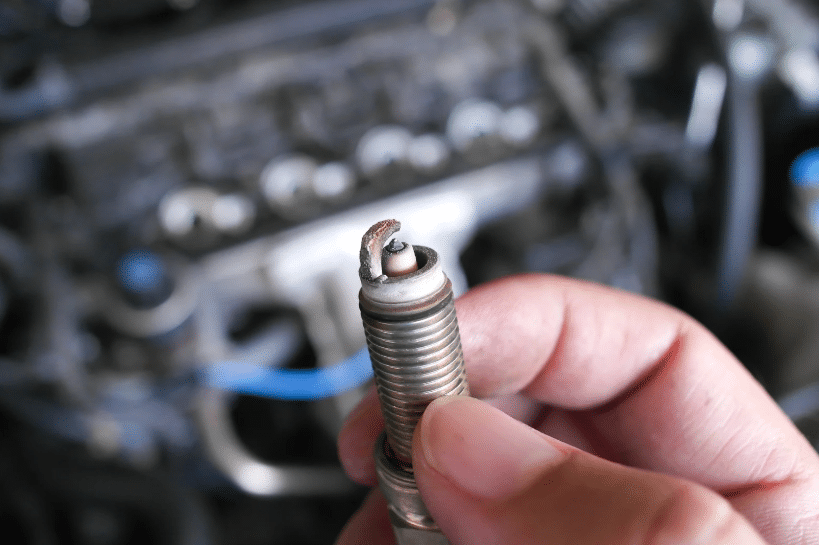
The wear happens at the electrode tip. Each spark erodes microscopic amounts of metal from the center electrode and ground strap. Over time, the gap between them widens. A new plug might have a gap of 0.040 inches; a worn plug at 100,000 miles might have a gap of 0.060 inches or more.
A wider gap requires higher voltage to fire. The ignition coil has to work harder to deliver that voltage, which generates more heat in the coil and shortens its life. Eventually the gap gets wide enough that the coil can't reliably bridge it, and the cylinder starts misfiring intermittently. The intermittent misfires get more frequent. Then the misfires get constant.
Carbon and oil deposits also build up on the plug tip over time, especially on engines with worn valve seals or in vehicles driven mostly on short trips. Deposits insulate the spark from the air-fuel mixture, weakening the ignition. Insulators crack from thermal cycling on aging plugs, which can short the spark to ground inside the plug instead of across the gap where it belongs. All of these failure modes show up as misfires.
The Real Service Interval (Spoiler: Higher Than Drivers Think)
Modern platinum and iridium spark plugs typically last 60,000 to 100,000 miles depending on the vehicle and engine design. Older copper-core plugs last about 30,000 miles. Some performance engines and turbocharged applications spec shorter intervals because the plugs work harder and run hotter.
The owner's manual is authoritative for your specific vehicle. Don't assume "100,000 miles" applies to your car just because that's the most common modern interval. Plenty of modern engines spec 60,000 or 75,000 miles, and exceeding the interval doesn't fail safely. It compounds.
Vehicle age also matters. Plugs spec'd for 100,000 miles on a vehicle driven 5,000 miles a year are still aging through 20 years of thermal cycling, deposit buildup, and electrode oxidation. Time-based replacement at the 8 to 10 year mark is reasonable even on low-mileage cars. Routine scheduled maintenance inspections track both intervals so the service doesn't get forgotten.
Hidden Cost #1: Fuel Economy You're Quietly Losing
Worn plugs produce incomplete combustion. The flame front spreads more slowly, the mixture burns less efficiently, and the engine extracts less energy from each gallon of gas. The fuel economy hit varies by engine and severity, but a 5 to 15 percent drop is typical on plugs that have gone well past their interval.
The math gets uncomfortable quickly. A vehicle that gets 25 MPG driving 15,000 miles a year burns 600 gallons of fuel annually. At $3.20 per gallon, that's $1,920 a year. A 10 percent efficiency loss adds roughly $190 a year to the fuel bill. Two years of that loss equals the cost of the spark plug job itself, in fuel alone, before any other downstream cost is added.
Most drivers don't notice the gradual decline because it happens slowly. The fuel gauge moves a little faster than it used to, but it's easy to attribute to traffic patterns, weather, or seasonal driving differences. A look at year-over-year fuel costs often reveals what daily perception misses.
Hidden Cost #2: Ignition Coil Damage
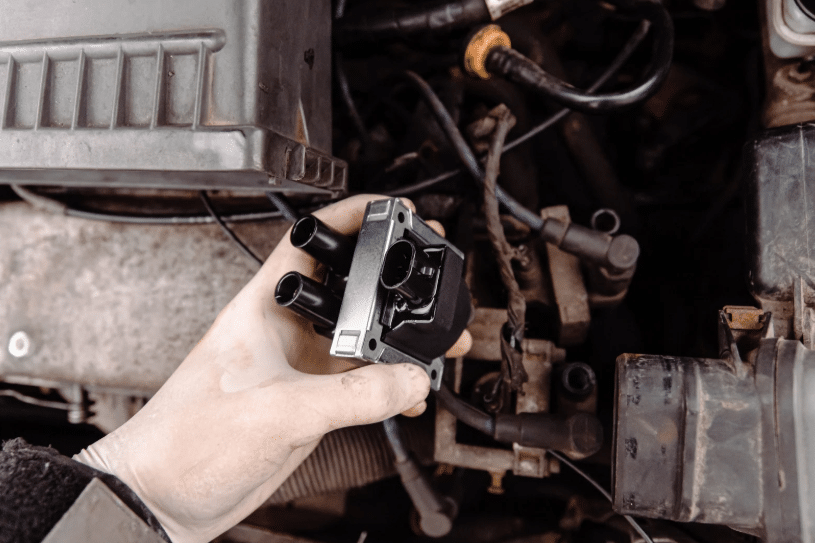
Modern engines use coil-on-plug ignition, which means each cylinder has its own dedicated ignition coil mounted directly on top of the spark plug. The coil generates the high voltage that fires the plug, typically 25,000 to 45,000 volts on demand.
When spark plug gaps widen from wear, the coil has to produce higher voltage to bridge the gap. That increased demand generates more heat inside the coil and stresses the internal windings. Coils run cool when plugs are fresh; they run hot when plugs are worn. Years of running hot to compensate for worn plugs shortens coil life dramatically.
The result is coil packs that fail at 80,000 miles instead of lasting the engine's life. A single coil typically costs $80 to $200, with labor adding another $50 to $150 per coil to install. On a V6 or V8 engine where multiple coils have failed simultaneously from years of compensating for worn plugs, the bill can climb past $800 to $1,200. All preventable by replacing the plugs on time.
Hidden Cost #3: Catalytic Converter Destruction
This is where deferred spark plug service moves from expensive to genuinely catastrophic. When a cylinder misfires, the unburned air-fuel mixture exits the cylinder and travels through the exhaust manifold into the catalytic converter. Inside the converter, the precious metal substrate sits at normal operating temperatures of 800 to 1,200°F. Raw fuel hitting that temperature ignites instantly.
The combustion happening inside the converter spikes internal temperatures to 2,000°F or higher. The ceramic honeycomb substrate that holds the catalyst material isn't designed for that heat. It melts, fuses into a solid mass, or shatters. Either way, the converter is destroyed, and the only fix is replacement.
Catalytic converter replacement runs $800 to $2,500 for most mainstream vehicles. European vehicles, hybrids, and trucks often run $1,500 to $4,000 because of larger or more complex converter designs and OEM-only parts. The repair often includes related work covered under exhaust services since the entire downstream system needs inspection after a misfire-related converter failure.
The detail that makes this especially frustrating is that converter damage from misfiring plugs is entirely preventable. A $250 spark plug service at the right interval prevents a $1,500-plus repair down the road. The cost ratio is brutal.
Hidden Cost #4: Oxygen Sensor and ECU Strain
Misfiring throws the engine's air-fuel ratio out of balance. The oxygen sensors monitoring the exhaust report unusual readings, and the engine control module compensates by adjusting fuel injection. Over time, the constant compensation can contaminate the oxygen sensors with carbon deposits and stress them with abnormal operating conditions.
Oxygen sensor replacement runs $150 to $400 per sensor depending on the vehicle, and modern engines often have four sensors. Replacing one or two oxygen sensors that wouldn't have failed without the underlying misfire problem is another cost that traces back to deferred spark plugs. Our breakdown of 12 common engine problems covers many of these cascade failures in more depth.
The ECU itself doesn't usually fail from this, but the fuel trim corrections it makes get baked into its long-term memory. Even after the spark plugs and downstream components are replaced, the engine sometimes runs slightly off until the trims relearn through normal driving cycles.
Hidden Cost #5: Tow Bills and Stranded Time
Spark plug failure rarely strands you on day one. It builds up. The misfires get worse over weeks or months, the engine power drops, and eventually the engine either won't start or runs so badly it can't be driven safely. By that point, the safe move is to pull over and call a tow truck.
Tow charges in the Decatur area typically run $75 to $200 for local moves, more for longer distances or after-hours service. Add the cost of a rental car for the days the vehicle is in the shop, missed work, rescheduled appointments, and the general disruption of an unplanned breakdown. None of that shows up on the spark plug service quote, but it's part of the actual cost of letting the maintenance go.
A flashing check engine light during driving is the universal signal that an active misfire is happening and damaging the converter in real time. Continuing to drive past a flashing CEL stacks more damage onto whatever already exists. The smart move is to pull over, get the vehicle towed, and have the diagnosis done before any more harm is added. Our article on what diagnostic trouble codes mean covers what specific codes indicate and which require immediate action.
The Symptom Progression You Should Recognize
The early signs of worn plugs are subtle. Fuel economy creeps down by a mile or two per gallon over months. The engine feels slightly less responsive than it used to. Idle quality may roughen slightly, especially at cold start. None of these symptoms is dramatic, and most drivers attribute them to other causes or don't notice at all.
The middle stages get more obvious. Hesitation during acceleration, especially under heavy throttle. A rough idle that you can feel through the steering wheel. The check engine light may come on with codes in the P0300 to P0308 range, which indicate misfires (P0300 is "random misfire," and P0301 through P0308 indicate specific cylinders).
The late stages are unmistakable. Constant rough running. Significant power loss. A check engine light that flashes during driving rather than glowing steady. At that point, the engine is actively misfiring under load, and continuing to drive accumulates damage to the catalytic converter and downstream components by the minute. This is when full engine repair becomes the conversation rather than simple maintenance.
What Spark Plug Service Actually Costs
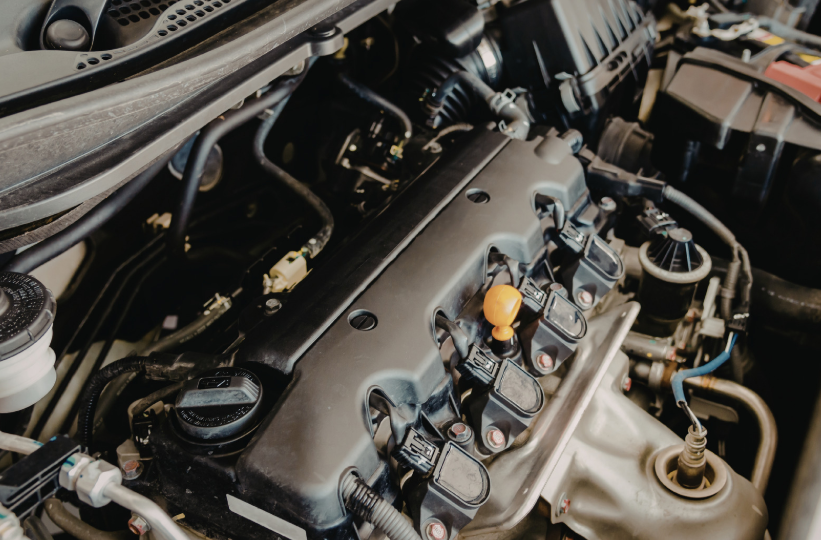
For most mainstream vehicles, spark plug replacement runs $150 to $300 on a four-cylinder engine, $200 to $450 on a V6, and $250 to $600 on a V8. Parts cost varies based on plug type (copper, platinum, double platinum, iridium) and OEM versus aftermarket choice. Quality iridium plugs from major brands like NGK, Denso, Bosch, and Champion typically cost $8 to $25 each at retail.
Labor is the bigger variable. Some engines have plugs that are easy to access, with a 30-minute total job. Other engines, especially V6 and V8 designs in modern transverse-mounted layouts, require removing the intake manifold or other components to reach the rear bank of plugs. That can stretch the job to 2 to 4 hours of labor.
European luxury vehicles often run higher because of OEM-spec plugs that cost more, more difficult access, and shorter recommended intervals. The general OEM vs. aftermarket parts discussion applies here, with the additional consideration that some engines are notably picky about which plug brands they tolerate without misfires.
Bundling related work makes sense when the engine is already opened up. Adding ignition coil replacement during a spark plug job costs the price of the coils plus minimal additional labor, versus a separate visit later that would require redoing all the access work.
What Decatur Conditions Mean for Spark Plug Life
Heat is hard on spark plug insulators and gradually accelerates electrode erosion. Decatur's long, hot summers mean engine bay temperatures sit at high levels for extended periods, which ages plugs faster than the same plugs would age in a milder climate.
Stop-and-go traffic on Scott Boulevard, Ponce de Leon, and the connector also affects plug life through a different mechanism. Engines that spend a lot of time at low speeds and low loads don't always reach full operating temperature for sustained periods. Carbon deposits accumulate on plug tips faster under these conditions because the mixture doesn't burn as cleanly as it does at steady highway speeds. Vehicles that get regular highway use tend to keep plugs cleaner and reach scheduled intervals without symptoms.
The practical effect is that Decatur plugs often need attention closer to the lower end of their rated interval rather than the higher end. A car spec'd at 100,000 miles for spark plugs may benefit from inspection or replacement closer to 80,000 if most of its driving has been in metro traffic.
Frequently Asked Questions
Can I just replace one or two plugs that are bad?
No. Spark plugs should always be replaced as a set, even if only one is fouled or misfiring. The plugs in an engine have all aged together under the same conditions, and replacing only one means the remaining old plugs will fail soon after, requiring the labor to be done again. Doing all of them at once is both cheaper long-term and more reliable.
How do I know if my plugs are due?
Check your owner's manual for the specified interval and compare it to your odometer. If you've passed the interval, they're due. If you're approaching it, plan to schedule the service in the next few thousand miles. If you're experiencing rough idle, fuel economy decline, or hesitation under acceleration, a diagnostic service appointment can confirm whether plugs are part of the problem.
Are platinum or iridium plugs worth the upgrade?
For most modern vehicles, yes. The longer service intervals (60,000 to 100,000 miles vs. 30,000 for copper) more than offset the higher per-plug cost. The main reason to choose copper is if your owner's manual specifically calls for it, which is uncommon on vehicles built in the last 15 years.
Do I need OEM plugs for European cars?
Often, yes. European engines, particularly BMW, Mercedes, Audi, VW, and Porsche, are notably particular about plug specifications. Wrong heat range, wrong gap, or wrong electrode design can cause misfires even with otherwise high-quality aftermarket plugs. Sticking with OEM or OE-equivalent plugs (NGK, Bosch, Denso depending on the manufacturer) is the safer choice on these vehicles.
Why is the labor cost so high if plugs are cheap?
On many modern engines, especially transverse V6 and V8 designs, reaching the spark plugs requires removing the intake manifold, throttle body, and various wiring and vacuum lines. The plugs themselves take 30 seconds each to install once they're accessible. The labor cost reflects the disassembly and reassembly time needed to access them on your specific engine.
What if my engine has already been misfiring for a while?
The longer misfires have been happening, the more downstream damage may have occurred. A proper diagnosis includes pulling stored fault codes, inspecting the catalytic converter for restriction or damage, evaluating ignition coil condition, and checking oxygen sensor function. Addressing the spark plugs alone may resolve the immediate symptoms, but additional repairs may be needed to fully restore the system if misfires have been going on for an extended period.
About Blue Ridge Automotive
Blue Ridge Automotive has served Decatur drivers since 2010 from our Decatur location, with additional convenient shops in Buckhead (Atlanta), Chamblee, and Marietta. Our ASE-certified technicians replace spark plugs to manufacturer spec on Asian, domestic, and European vehicles, and we evaluate ignition coil and downstream component condition during the same visit so you don't pay for repeat service. Every job is backed by a 24,000-mile, 24-month warranty on parts and labor through TechNet, which means real coverage on a maintenance item that protects much more than just the engine's idle quality.
Don't Let a $250 Job Become a $1,500 One
If your car is past its spark plug service interval, or if you've noticed any of the symptoms covered above, the smart move is to schedule the service before the cascade of downstream costs starts. Our technicians can confirm your vehicle's exact interval, evaluate current spark plug condition, and complete the replacement with the right plugs for your specific engine.
Call (404) 549-9424 or schedule a service online to book your spark plug service at the Blue Ridge Automotive Decatur location.